
Genesis 9:24 to 10:32
The Spread of Nations
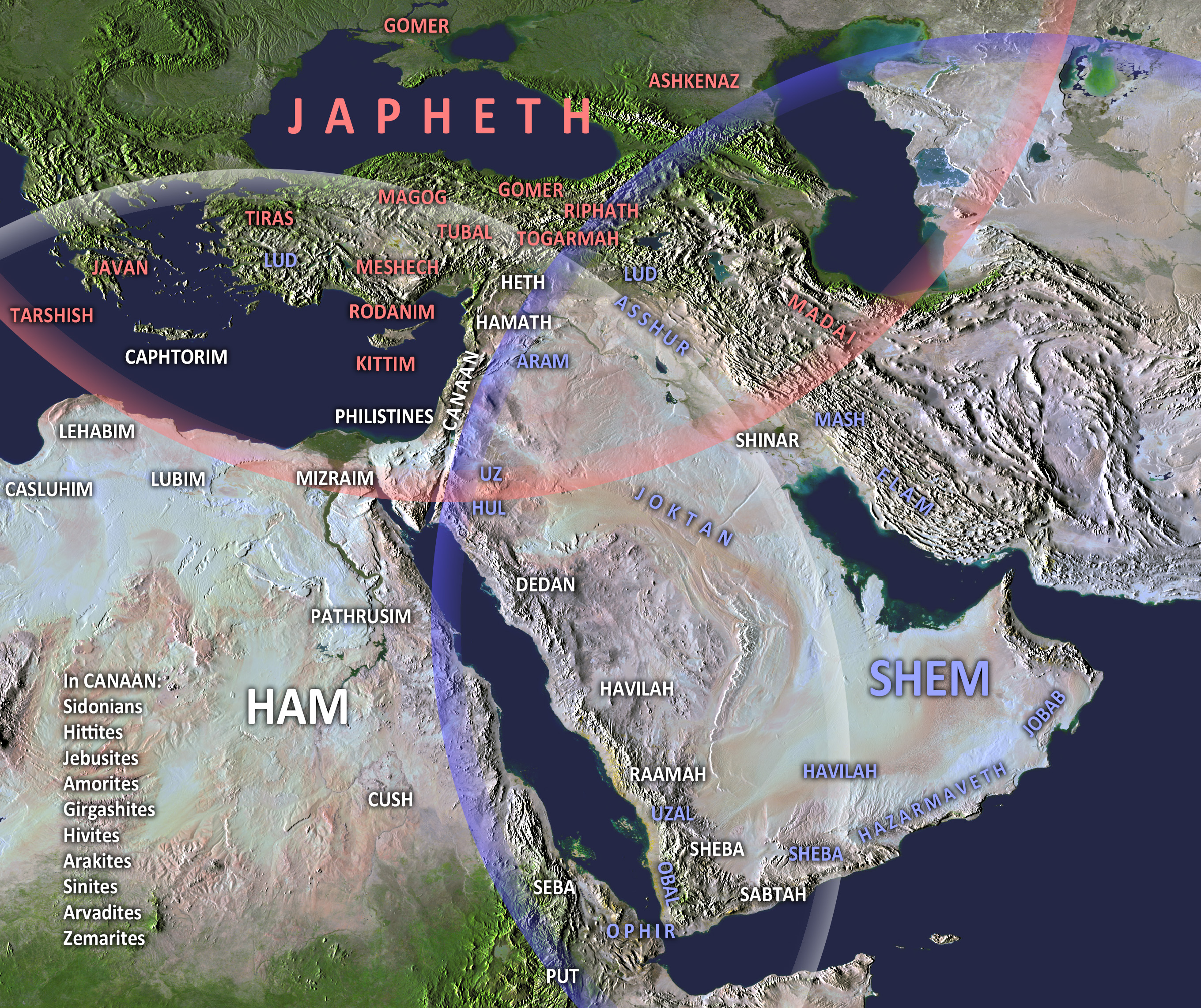
Image Caption: Table of Nations (Genesis 10).Source: Satellite relief map of Middle East (Wikimedia) [https://upload.wikimedia.org/wikipedia/commons/c/cd/Satellite_relief_map_of_Middle_East.png]
Curse of Canaan Genesis 9:24-29
To understand the rhetorical purpose of any part of Genesis, one must discern the role it plays in the book's overall strategy for its intended readers. Because the book of Genesis bears indicators of having been periodically supplemented during its development, modern readers may need to grapple with subtle changes of perspective among the editorial strata of the book.
Genesis 9:24-29, which portrays Noah exposed in a drinken state and his son Ham as a wanton gauker, is a dismal denouement to the flood story, which thus ends as it began with a scene of human debauchery. When Noah sobers, he brings a curse on Ham's son, befitting Ham's contempt toward his father, which propels the story of final human judgment still further into the future.
The account of the curse of Canaan, in Genesis 9:24-29, seems intended to provide rationale for Israel's conquest of Canaan, when Israel was tasked with removing Canaanite peoples and cultural influence from the land God had promised Abram (see Genesis 12:7; 15:13-16; 17:8; Numbers 13:2; Deuteronomy 7:2; Joshua 1:6, 11; 23:7-13; Judges 1). Ostensibly, the story of the curse of Canaan supports Israel's conquest of Canaan by characterizing Canaan as an accursed people descended from one given to wanton impropriety. As elsewhere in Genesis, stories about tribal patriarchs come to characterize their descendents, as well:
- the portrayal of Ishmael as a violent rival in Genesis 16; 17:20, 23-26; 21:8-21; and 25:12-18 characterizes tribal Ishmael, as well — 'a wild donkey of a man; his hand will be against everyone and everyone’s hand against him, and he will live in hostility toward[b] all his brothers' (16:12) and 'they lived in hostility toward all their brothers' (25:18)
- the portrayal of Esau as an interbreeding rival in Genesis 25:24-34 and 36:8-9 characterizes tribal Edom, as well
- the portrayal of Lot as a culturally compromising rival in Genesis 13:5-13 and an inbreeder in 19:30-38 characterizes Moab and the sons of Ammon, as well
Genesis 9:20-23
The following sin of Ham, the father of Canaan, is an act of disrespect and lewdness akin to that between the sons of God and the daughters of Man that had formerly moved YHWH to destroy the earth.
| כ וַיָּחֶל נֹחַ אִישׁ הָאֲדָמָה; וַיִּטַּע, כָּרֶם. | 20 And Noah the husbandman began, and planted a vineyard. |
| כא ַיֵּשְׁתְּ מִן-הַיַּיִן, וַיִּשְׁכָּר; וַיִּתְגַּל בְּתוֹךְ אָהֳלֹה. | 21 And he drank of the wine and became drunk; and he was uncovered in his tent. |
| כב וַיַּרְא, חָם אֲבִי כְנַעַן, אֵת, עֶרְוַת אָבִיו; וַיַּגֵּד לִשְׁנֵי-אֶחָיו, בַּחוּץ. | 22 And Ham, the father of Canaan, saw the nakedness of his father, and told his two brethren without. |
| כג וַיִּקַּח שֵׁם וָיֶפֶת אֶת-הַשִּׂמְלָה, וַיָּשִׂימוּ עַל-שְׁכֶם שְׁנֵיהֶם, וַיֵּלְכוּ אֲחֹרַנִּית, וַיְכַסּוּ אֵת עֶרְוַת אֲבִיהֶם; וּפְנֵיהֶם, אֲחֹרַנִּית, וְעֶרְוַת אֲבִיהֶם, לֹא רָאוּ. | 23 And Shem and Japheth took a garment, and laid it upon both their shoulders, and went backward, and covered the nakedness of their father; and their faces were backward, and they saw not their father's nakedness. |
Because the sin of Ham had been to disrespect the sanctity of the father–son relation, Noah chooses to curse Ham not directly, but relationally, by cursing Ham's own son, Canaan. The curse is thus continuous, because it is leveled against Ham's lineage.
Genesis 9:24-27
With the sobering of Noah, the curse of Canaan follows. This prophetic passage will grant the tribes of Israel justification for YHWH's holy war against the Canaanites and his eventual edict commissioning Israel to exterminate Canaan from the promised land.
| כד וַיִּיקֶץ נֹחַ, מִיֵּינוֹ; וַיֵּדַע, אֵת אֲשֶׁר-עָשָׂה לוֹ בְּנוֹ הַקָּטָן. | 24 And Noah awoke from his wine and knew what his youngest son had done unto him. |
| כה וַיֹּאמֶר, אָרוּר כְּנָעַן: עֶבֶד עֲבָדִים, יִהְיֶה לְאֶחָיו. | 25 And he said: Cursed be Canaan; a servant of servants shall he be unto his brethren. |
| כו וַיֹּאמֶר, בָּרוּךְ יְהוָה אֱלֹהֵי שֵׁם; וִיהִי כְנַעַן, עֶבֶד לָמוֹ. | 26 And he said: Blessed be YHWH, the God of Shem; and let Canaan be their servant. |
| כז יַפְתְּ אֱלֹהִים לְיֶפֶת, וְיִשְׁכֹּן בְּאָהֳלֵי-שֵׁם; וִיהִי כְנַעַן, עֶבֶד לָמוֹ. | 27 God enlarge Japheth, and he shall dwell in the tents of Shem; and let Canaan be their servant. |
Genesis 9:28-29
The last two verses of the denouement are a resumption of the genealogy of Genesis 5.
| כח ַיְחִי-נֹחַ, אַחַר הַמַּבּוּל, שְׁלֹשׁ מֵאוֹת שָׁנָה, וַחֲמִשִּׁים שָׁנָה. | 28 And Noah lived after the flood three hundred and fifty years. |
| כט וַיִּהְיוּ, כָּל-יְמֵי-נֹחַ, תְּשַׁע מֵאוֹת שָׁנָה, וַחֲמִשִּׁים שָׁנָה; וַיָּמֹת. {פ} | 29 And all the days of Noah were nine hundred and fifty years; and he died. {P} |
500 is a multiple of 5: (cf. Gen. 5:32, "And Noah was five hundred years old; and Noah bore Shem, Ham, and Japheth")
- 102 x 5 = 500
- 22 x 53 = 500 (prime factors)
600 is a multiple of 3, 3, and 5: (cf. Gen. 7:6, "In the six hundredth year of Noah's life, in the second month, on the seventeenth day of the month … ")
- 60 (sexagesimal) x 10 = 600
- 23 x 3 x 52 = 600 (prime factors)
350 is a multiple of 5 and 7:
- 10 x 7 x 5 = 350
- 2 x 52 x 7 = 350 (prime factors)
The sum of 600 + 350 is 950:
- (102 x 5) + (10 x 7 x 5) = 950
- 2 x 52 x 19 = 950 (prime factors)
NOTE: If the age of Noah 'after' the flood were 601, then Noah should have lived to 951: (cf. Genesis 8:13, "And it came to pass in the six hundred and first year, in the first month, the first day of the month … ")
- 1 x 601 = 601 (prime)
- 3 x 317 = 951 (prime factors)
Seventy Nations Genesis 10:1-32
It is no coincidence that the final form of the Table of Nations (Genesis 10:1-32) should be centered on the land of Canaan, the intersection of regions populated by descendants of Shem, Japheth, and Ham. The compiler who included the account of Noah's curse of Canaan (Genesis 9:24-29) was making a polemic point, but he was also transitioning to a worldwide vision that depicts the promised land at its center.
It is also not coincidental that the Table of Nations accounts for just 70 nations (excluding Nimrod in 10:8–12) since according to Deuteronomy 32:8,
When the Most High gave the nations their inheritance,
when he separated the sons of men,
he fixed the boundaries of the peoples
according to the number of the sons of Israel / God.
The Masoretic Hebrew text has 'sons of Israel' (bene yisraʾel); however, the LXX and Qumran text 4QDeutj witness an original 'sons of God' (bene ʾelohim), saying that God divided world nations in accordance with the number of his 'sons' in the heavenly council. Seventy is a number often applied to administrative councils (e.g., Jacob's descendants in Egypt [Exodus 1:5], elders of Israel [Exodus 24:1-2; Numbers 11:16-17, 24-26], and it continued to be applied even until the Sanhedrin council [Sanhedrin 1:4]), so it should not surprise us that the author of Deuteronomy 32:8 expected God's heavenly assembly to comprise 70 'sons of God', as well.
The Nimrod polemic section (Genesis 10:8-12) and the triangular border of Canaan apostrophe (Genesis 10:19) are commonly regarded as supplements to an earlier version of the Table of Nations that had 70 nations.
tôledôṯ of the Sons of Noah: Shem, Ham, Japheth
Rhetoric
This patronymic genealogical lineage shows the result of the dispersion of ethnic subgroups after the societal judgment account that follows (Gen. 11:1-9). It is in reverse order with the following passages, therefore, following the pattern: first the consequences, then the cause.
Allen P. Ross has noted the role of this ethnic genealogical table as outlining the relation of Israel to those nations most important to Israel's emergence and to their anthropological, linguistic, political, and geographical identity as a people of the world (Creation and Blessing: A Guide to the Study and Exposition of Genesis [Grand Rapids: Baker, 1988], ch. 16/pp. 221-32).
Genre
The section is a mixture of horizontal and vertical genealogies. The role of the genealogy is mostly that of a horizontal genealogy (especially in regard to the lines of Japheth and Ham), though it finishes with a vertical concern with the elect line of Shem.
Structure
- Introductory summary — 10:1
- Japheth — 10:2–5
- Ham — 10:6–20
- Supplement: Nimrod — 10:8-12
- Supplement: Borders of Canaan — 10:19
- Shem — 10:21–31
- Concluding colophon — 10:32
Symbolism
Noah
Japheth
10:2-5
7 + 3 + 4 = 14
14
Ham
10:6-20
4 + 5 + 2 + 1 = 12
7 + 1 + 1 + 10 = 19
31
Shem
10:21-31
5 + 4 + 2 + 2 = 13
13
26
The genealogy is trifid, and the total number of foreign nations, seventy (70), continues the 3 x 7 patterning observed in Genesis 1 and 5.
Seventy is a multiple of primes 7 and 5 and 2:
- 7 x 5 x 2 = 70 (prime factors)
The number 70 symbolizes administrative totality.
Seventy is the number of Jacob’s family that went to Egypt: ‘Seventy souls went down to Egypt to begin the Hebrews' Egyptian exile’ (Genesis 46:27).
Deuteronomy 32:8-9 says:
8 When the Most High gave the nations their inheritance,
when he divided all mankind,
he set up boundaries for the peoples
according to the number of the sons of Israel / God.
9 For YHWH’s portion is his people,
Jacob his allotted inheritance.
Seventy elders were assembled in the desert by Moses at God's command (Numbers 11:16-30).
The Greek Torah (Septuagint) was allegedly a translation by a college of 70 scholars (hence LXX).
The later Sanhedrin was made up of 70 ruling judges (Sanhedrin 1:4).
Genealogy of Noah: Nation Migrations
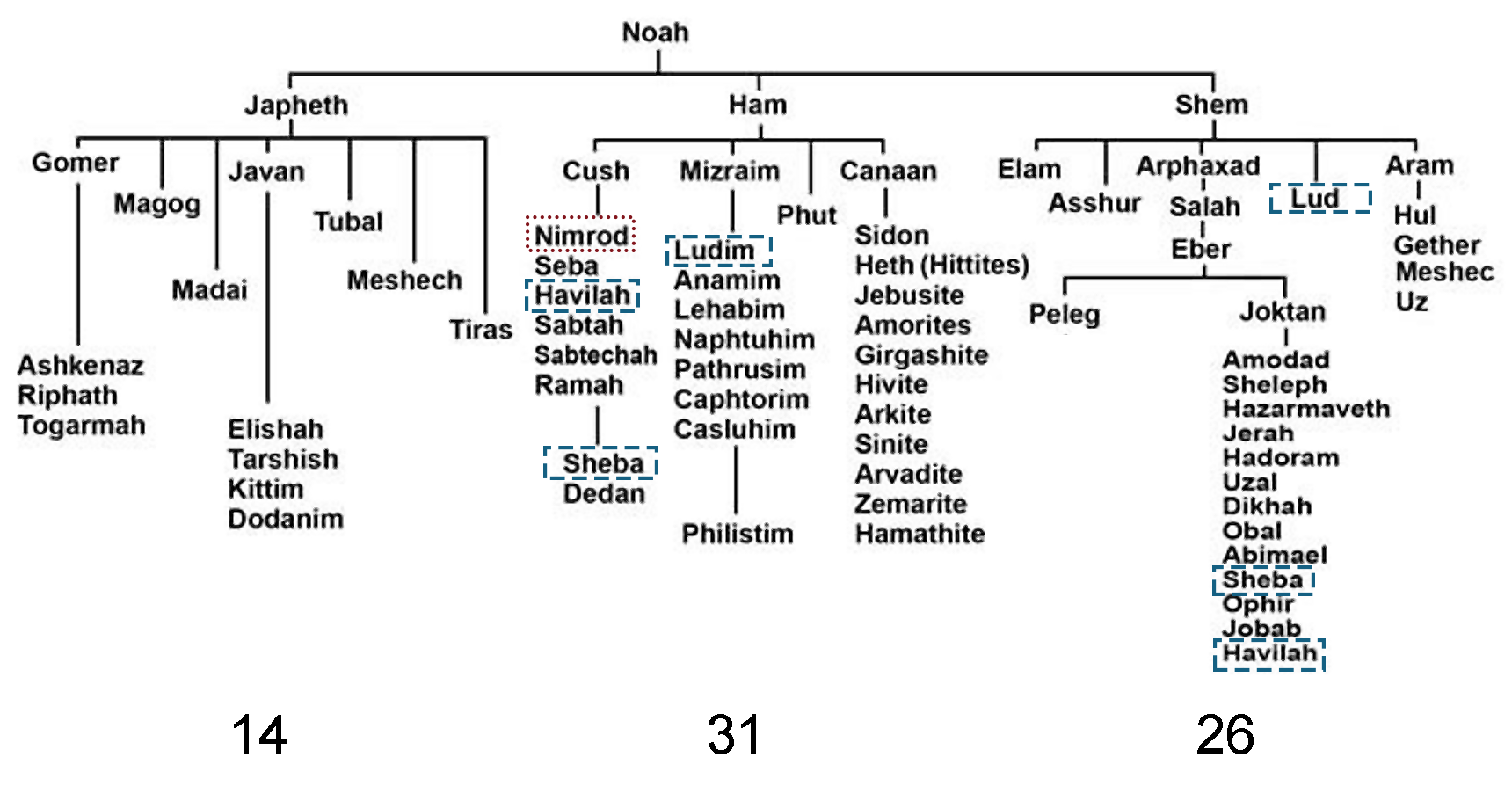
Image Caption: Genealogy of Noah in the Table of Nations (Genesis 10).Source: Satellite relief map of Middle East (Wikimedia) [https://upload.wikimedia.org/wikipedia/commons/c/cd/Satellite_relief_map_of_Middle_East.png]
Owing to the possiblity that the compiler of Noah's genealogy in Genesis 10 inherited distinct tribal traditions or to the possibility that Noah's genealogy conflates descendency with geographical or political proximity, three nations are listed twice, suggesting their peoples came from both Ham and Shem. They are Sheba (10:7, 28); Havilah (10:7, 29); and Ludim / Lud (10:13, 22) (cf. John Day, Table of Nations).
| Hamitic | Semitic | Locations | Linguistic Groups |
|---|---|---|---|
| Sheba (10:7) | Sheba (10:28) | South Arabia (Yemen) | Old South Arabian (Sabaic) |
| Havilah (10:7) | Havilah (10:29) | West / Northwest Arabia (Midia) | Northwest Arabian (Ḥawil) |
| Ludim (10:13) | Lud (10:22) | Caucuses / Anatolia (Lydia) | Indo-European (Lydian) |
Image Caption: Map of the Table of Nations in Genesis 10. Source: Satellite relief map of Middle East (Wikimedia) [https://upload.wikimedia.org/wikipedia/commons/c/cd/Satellite_relief_map_of_Middle_East.png]
Regarding Sheba and Havilah, it may be reasonable to infer that both Hamitic and Semitic tribal traditions claim them — socio-linguistic people groups were known to have migrated geographically or to have shifted linguistically or politically over time. As to Ludim / Lud, migration may account for at least subgroup relocation and their linguistic assimilation to that of their settlement region, whether Anatolian or Caucasian.
Recent Human Migrations by Cultural Era
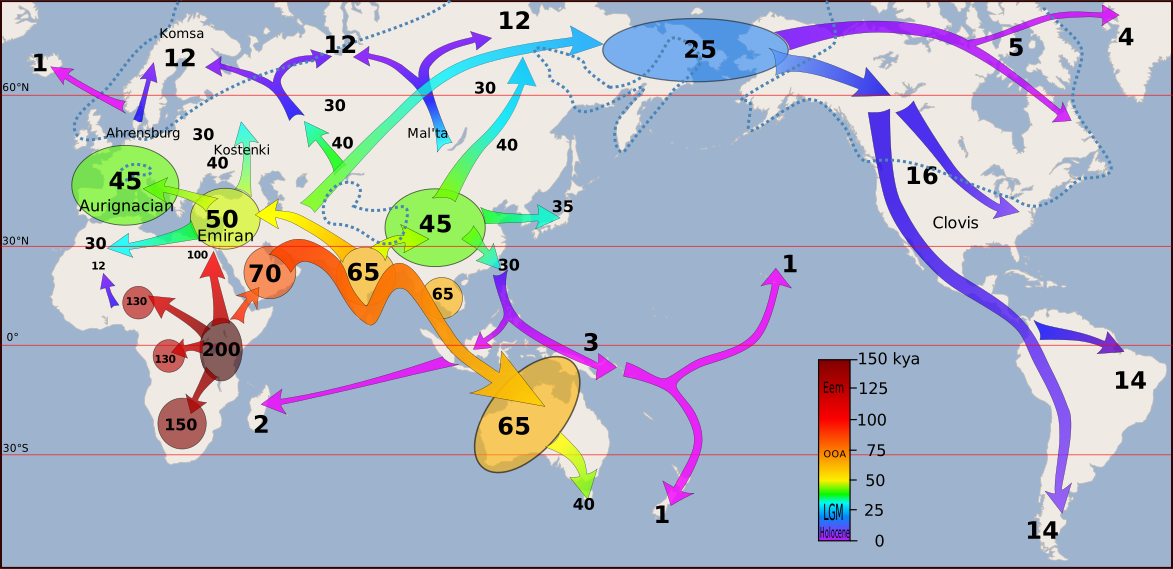 Image Caption: Recent Human Migrations by Era. Sources: Early human migrations: Coastal migration (Wikipedia) [https://en.wikipedia.org/wiki/Early_human_migrations#/media/File:Early_migrations_mercator.svg]
According to DNA research on indigenous peoples, the so-called "recent dispersal" of modern humans took place beginning 70,000 to 50,000 years ago. This migration led to the spread of modern humans throughout the world. In a broad view, this comports with the claims of Genesis 10, which maps the distribution of neighboring nations of Canaan as a result of descendency from three common-ancestor groups Shem, Ham, and Japeth.
Image Caption: Recent Human Migrations by Era. Sources: Early human migrations: Coastal migration (Wikipedia) [https://en.wikipedia.org/wiki/Early_human_migrations#/media/File:Early_migrations_mercator.svg]
According to DNA research on indigenous peoples, the so-called "recent dispersal" of modern humans took place beginning 70,000 to 50,000 years ago. This migration led to the spread of modern humans throughout the world. In a broad view, this comports with the claims of Genesis 10, which maps the distribution of neighboring nations of Canaan as a result of descendency from three common-ancestor groups Shem, Ham, and Japeth.
Source: Early human migrations (Wikipedia) [https://en.wikipedia.org/wiki/Early_human_migrations]
Emiran culture emerged in the Levant (Lebanon, Syria, Israel, Jordan, Egypt and Arabia) between the Middle Paleolithic and the Upper Paleolithic periods. It is the oldest known of the Upper Paleolithic cultures and remains an enigma as it has no clear African progenitor. Some scholars conclude that the Emiran is indigenous to the Levant. However, others say it reflects technological trends observed previously in North Africa, at old sites such as Taramsa 1 in Egypt, "which contains modern human remains dating to 75,000 years ago".
Source: Emiran (Wikipedia) [https://en.wikipedia.org/wiki/Emiran]
The Aurignacians were an early modern human culture in Europe, existing from about 43,000 to 26,000 years ago during the Upper Paleolithic period. They are known for advanced tool-making, cave art, and symbolic expressions, marking significant developments in human culture. An Aurignacian culture is also found in the Levant, having blade technology similar to that of European Aurignacians, succeeding the Emiran and Early Ahmarian in the same area of West Asia and likely related to them. The Levantine Aurignacian may have preceded the European Aurignacian culture.
Source: Aurignacian (Wikipedia) [https://en.wikipedia.org/wiki/Aurignacian]
Migrations Measured by Genetic Markers
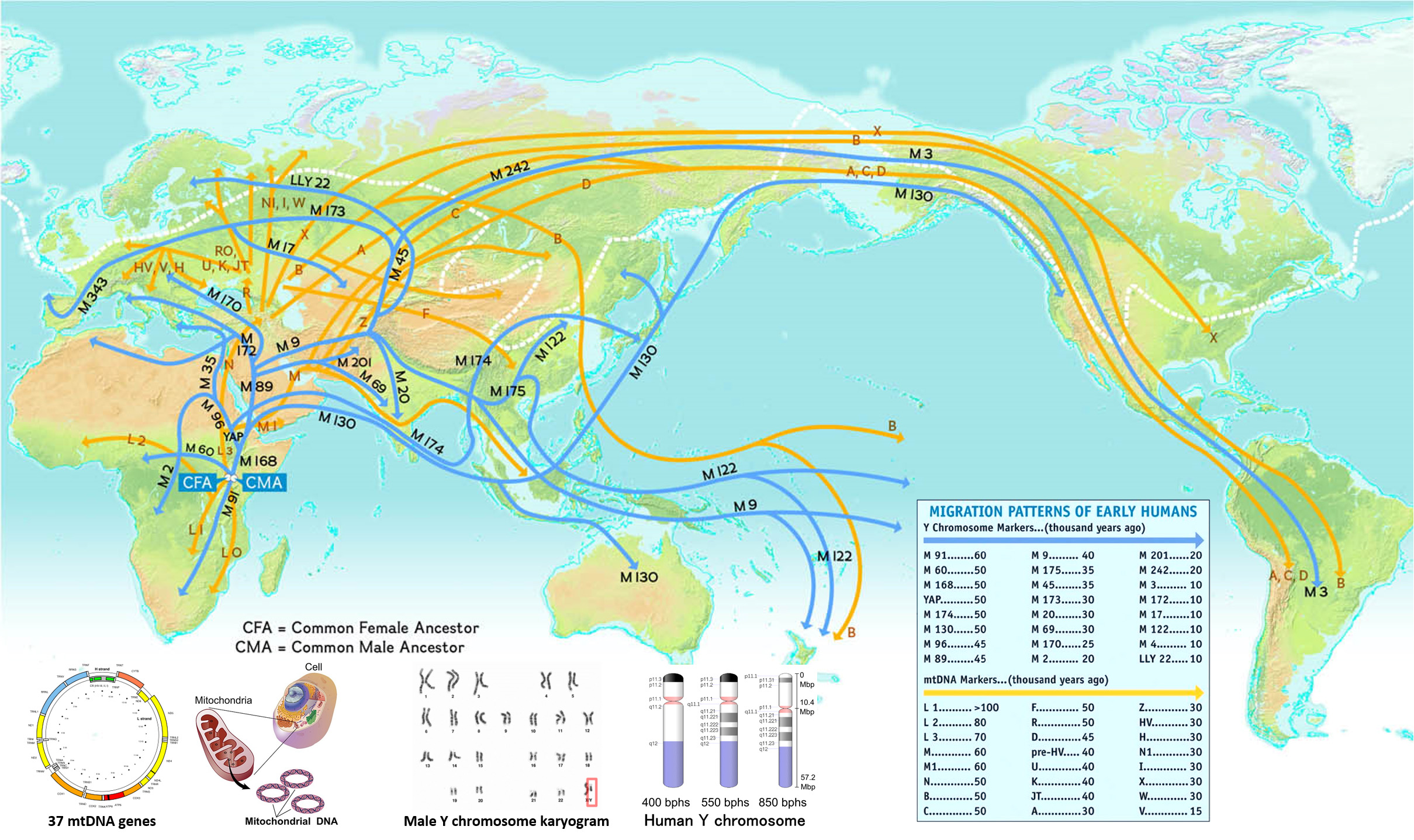 Image Caption: Human genetic migration of female mtDNA versus male Y-chromosome. Sources: [https://brewminate.com/wp-content/uploads/2017/03/Language18.jpg] and Mitochondrial DNA (Wikipedia) [https://en.wikipedia.org/wiki/Mitochondrial_DNA] and Y chromosome (Wikipedia) [https://en.wikipedia.org/wiki/Y_chromosome]
There may be value in comparing the social groupings of Genesis 10 with the genetic groupings of modern research into the origins and spread of peoples on Earth. Through discoveries in genetic research, it is possible to map human migration patterns by sampling key genetic markers of indigenous people groups and remains of their ancestors. As key genetic markers mutate, they become trace markers that characterize only certain groups and the subgroups that descend from them.
Image Caption: Human genetic migration of female mtDNA versus male Y-chromosome. Sources: [https://brewminate.com/wp-content/uploads/2017/03/Language18.jpg] and Mitochondrial DNA (Wikipedia) [https://en.wikipedia.org/wiki/Mitochondrial_DNA] and Y chromosome (Wikipedia) [https://en.wikipedia.org/wiki/Y_chromosome]
There may be value in comparing the social groupings of Genesis 10 with the genetic groupings of modern research into the origins and spread of peoples on Earth. Through discoveries in genetic research, it is possible to map human migration patterns by sampling key genetic markers of indigenous people groups and remains of their ancestors. As key genetic markers mutate, they become trace markers that characterize only certain groups and the subgroups that descend from them.
In human reproduction, mitochondria are inherited almost exclusively from the mother. Mitochondria in sperm are usually destroyed by the egg cell after fertilization. So, mitochondrial DNA (mtDNA) with its trace variations proves to be a tell-tale marker of female inheritcance in the history of the human genome. The fact that mitochondrial DNA is maternally inherited enables genealogical researchers to trace maternal lineage far back in time.
Y-chromosomal DNA, on the other hand, is only paternally inherited, so it has been used by genetic historians to trace patrilineal history. It is here that we find opportunity for comparing the Genesis 10 genealogical record with genetic record of Y-chromosome migrations, because Genesis 5 and 10, as well as the distribution of Y-chromosomal DNA, tell a story of male decendency.
Biblical Adam versus Y-chromosomal Adam
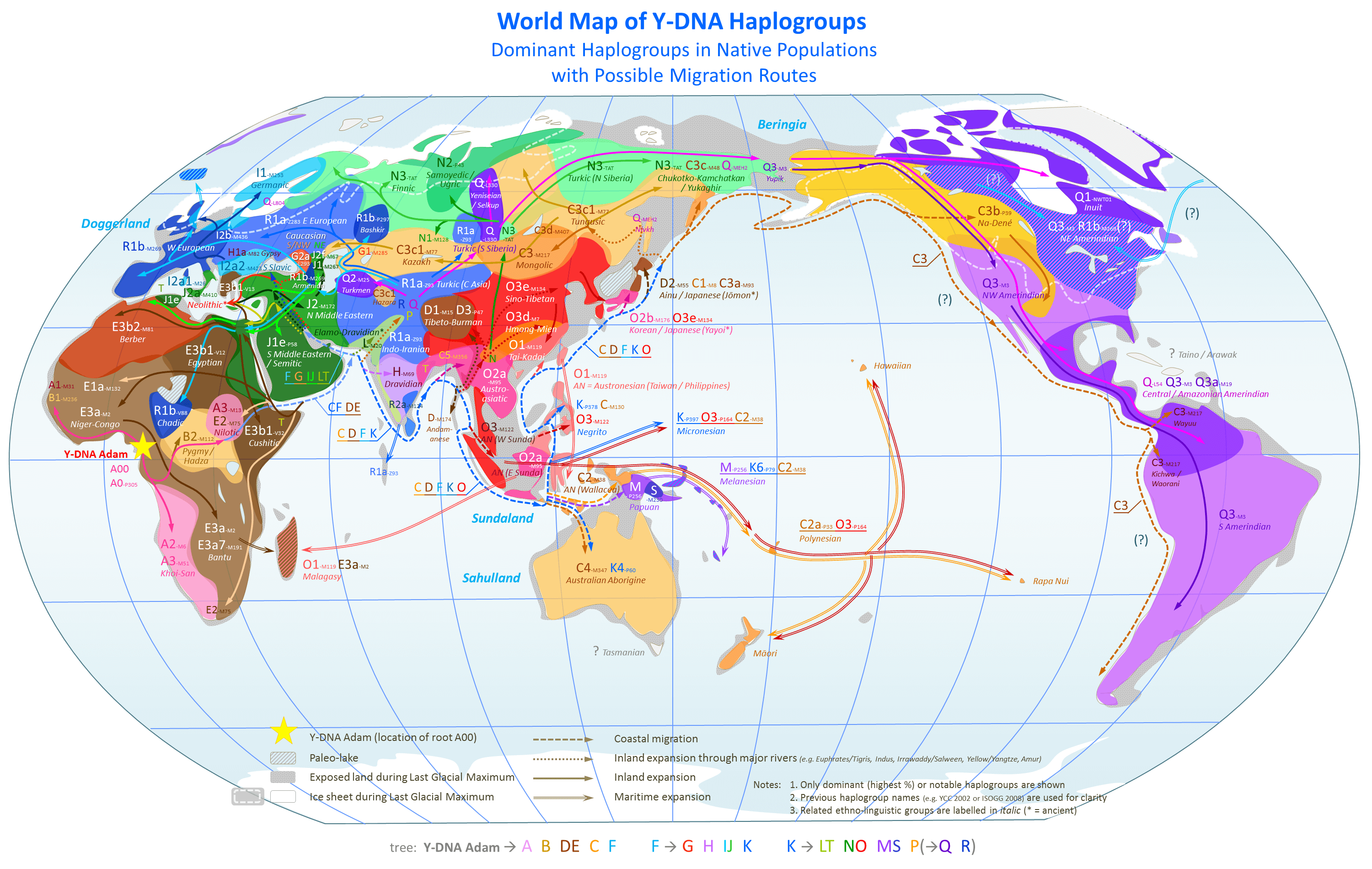 Image Caption: Map of the distribution of Y-chromosome DNA haplogroups by trace markers. Sources: Human Y-chromosome DNA haplogroup (Wikipedia) [https://en.wikipedia.org/wiki/Human_Y-chromosome_DNA_haplogroup] and [https://upload.wikimedia.org/wikipedia/commons/c/ca/World_Map_of_Y-DNA_Haplogroups.png]
The Y-chromosomal 'most recent common ancestor' (Y-MRCA), referred to as 'Y-chromosomal Adam', is the most recent common ancestor from whom all living humans are patrilineally descended. Y-chromosomal Adam is alleged to have lived around 236,000 years ago in Africa. If we follow the record of Genesis 5, 6–9, and 10, the Y-chromosomal most recent common ancestor ought be biblical Noah, not biblical Adam — that is, if biblical flood were universal and Noah were the sole patrilineal source of Y-chromosomal DNA among all survivors of the great flood.
Image Caption: Map of the distribution of Y-chromosome DNA haplogroups by trace markers. Sources: Human Y-chromosome DNA haplogroup (Wikipedia) [https://en.wikipedia.org/wiki/Human_Y-chromosome_DNA_haplogroup] and [https://upload.wikimedia.org/wikipedia/commons/c/ca/World_Map_of_Y-DNA_Haplogroups.png]
The Y-chromosomal 'most recent common ancestor' (Y-MRCA), referred to as 'Y-chromosomal Adam', is the most recent common ancestor from whom all living humans are patrilineally descended. Y-chromosomal Adam is alleged to have lived around 236,000 years ago in Africa. If we follow the record of Genesis 5, 6–9, and 10, the Y-chromosomal most recent common ancestor ought be biblical Noah, not biblical Adam — that is, if biblical flood were universal and Noah were the sole patrilineal source of Y-chromosomal DNA among all survivors of the great flood.
It should be obvious that the human genetic history of patrilineage depicted by Y-chromosome DNA differs significantly from the patrilineal descendency traced in Genesis from Adam to the descendents of Noah. The Table of Nations was evidently not intended to account for the derivation of every people group on Earth at the time of its writing — instead, it features a representative 70 nations that shared geopolitical currency with the inhabitants of Canaan, particularly with the people of Israel who would come to possess it (cf. Richard P. Aschmann, "The Genesis 10 Table of Nations and Y-Chromosomal DNA" [February 17, 2022] [https://aschmann.net/BibleChronology/Genesis10.pdf]).
Shem, Ham, Japheth Y-chromosomal Haplogroups
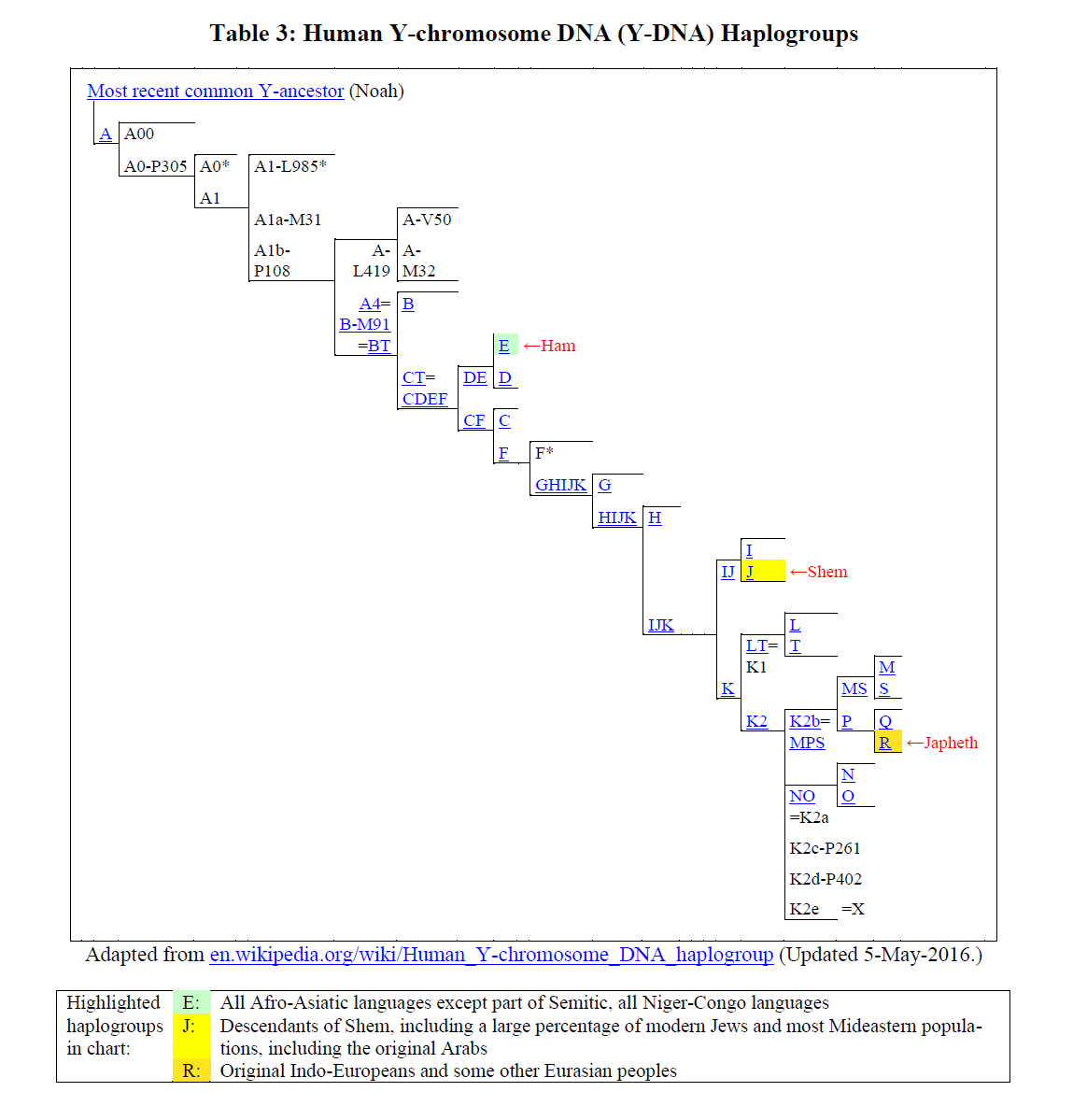 Image Caption: Standard Y-chromosome haplogroup alignment with Shem, Ham, and Japheth. Source: Richard P. Aschmann, "The Genesis 10 Table of Nations and Y-Chromosomal DNA" (February 17, 2022) [https://aschmann.net/BibleChronology/Genesis10.pdf] as adapted from [https://en.wikipedia.org/wiki/Human_Y-chromosome_DNA_haplogroup]
Richard P. Aschmann ("The Genesis 10 Table of Nations and Y-Chromosomal DNA", 2022) plotted Noahic descendency on the standard Y-chromosome genogram to show Shem, Ham, Japheth as deriving indirectly from intermediary haplogroup mutations. This model requires interpreting biblical 'son of' in a broader sense: 'descendent of'.
Image Caption: Standard Y-chromosome haplogroup alignment with Shem, Ham, and Japheth. Source: Richard P. Aschmann, "The Genesis 10 Table of Nations and Y-Chromosomal DNA" (February 17, 2022) [https://aschmann.net/BibleChronology/Genesis10.pdf] as adapted from [https://en.wikipedia.org/wiki/Human_Y-chromosome_DNA_haplogroup]
Richard P. Aschmann ("The Genesis 10 Table of Nations and Y-Chromosomal DNA", 2022) plotted Noahic descendency on the standard Y-chromosome genogram to show Shem, Ham, Japheth as deriving indirectly from intermediary haplogroup mutations. This model requires interpreting biblical 'son of' in a broader sense: 'descendent of'.
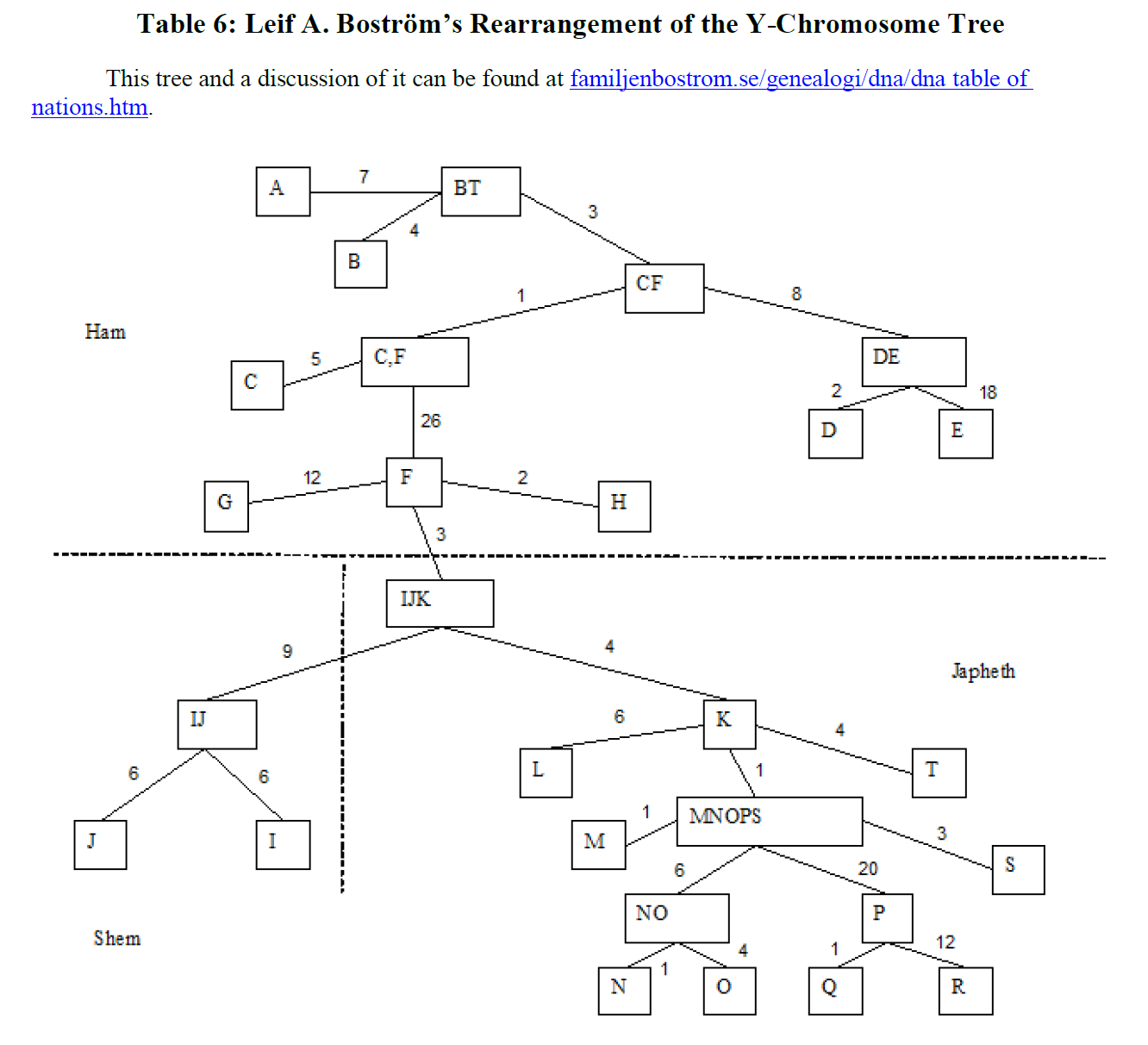 Image Caption: Genogram of Y-chromosome haplogroups arranged to show Noahic descendency. Source: Richard P. Aschmann, "The Genesis 10 Table of Nations and Y-Chromosomal DNA" (February 17, 2022) [https://aschmann.net/BibleChronology/Genesis10.pdf]
Leif A. Boström ("Genetic Table of Nations", 2014) rearranged the standard Y-chromosome haplogroup genogram to show Noahic dispersion. To accomplish this, Boström proposes to reverse the standard model descendency of Y-chromosome haplogroups within the 'Ham' family tree.
Image Caption: Genogram of Y-chromosome haplogroups arranged to show Noahic descendency. Source: Richard P. Aschmann, "The Genesis 10 Table of Nations and Y-Chromosomal DNA" (February 17, 2022) [https://aschmann.net/BibleChronology/Genesis10.pdf]
Leif A. Boström ("Genetic Table of Nations", 2014) rearranged the standard Y-chromosome haplogroup genogram to show Noahic dispersion. To accomplish this, Boström proposes to reverse the standard model descendency of Y-chromosome haplogroups within the 'Ham' family tree.
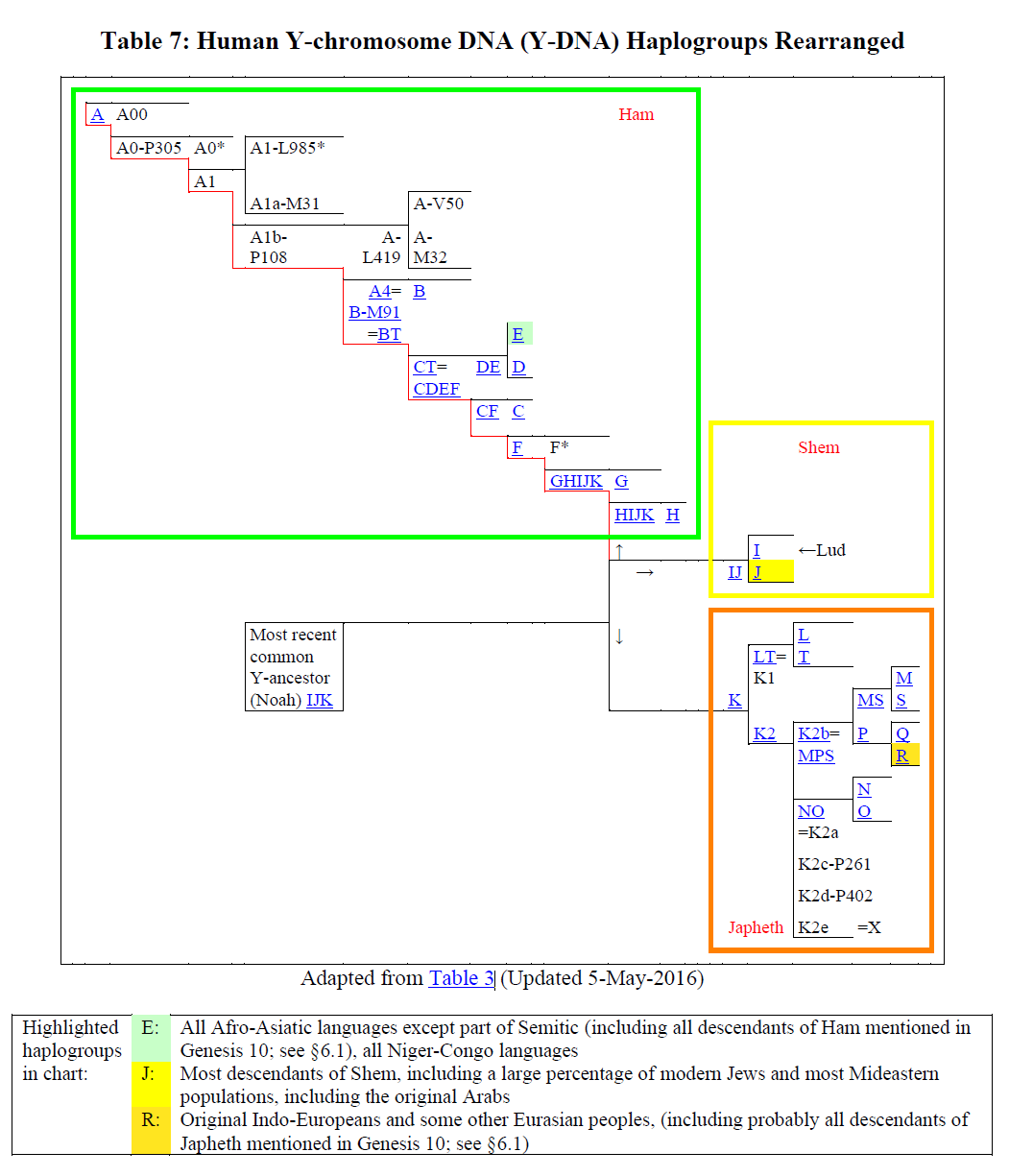 Image Caption: Y-chromosome haplogroups rearranged to show Noahic descendency. Source: Richard P. Aschmann, "The Genesis 10 Table of Nations and Y-Chromosomal DNA" (February 17, 2022) [https://aschmann.net/BibleChronology/Genesis10.pdf]
Accordingly, Aschmann restructured his standard Y-chromosome flow diagram to show a new starting point for Noah's haplogroup ('IJK'), matching Boström's reversed structure for the Hamitic tree (reversed Y-chromosome mutations shown using red lines whose side branches are not reversed).
Image Caption: Y-chromosome haplogroups rearranged to show Noahic descendency. Source: Richard P. Aschmann, "The Genesis 10 Table of Nations and Y-Chromosomal DNA" (February 17, 2022) [https://aschmann.net/BibleChronology/Genesis10.pdf]
Accordingly, Aschmann restructured his standard Y-chromosome flow diagram to show a new starting point for Noah's haplogroup ('IJK'), matching Boström's reversed structure for the Hamitic tree (reversed Y-chromosome mutations shown using red lines whose side branches are not reversed).
Noahic Tribal Distributions by Location
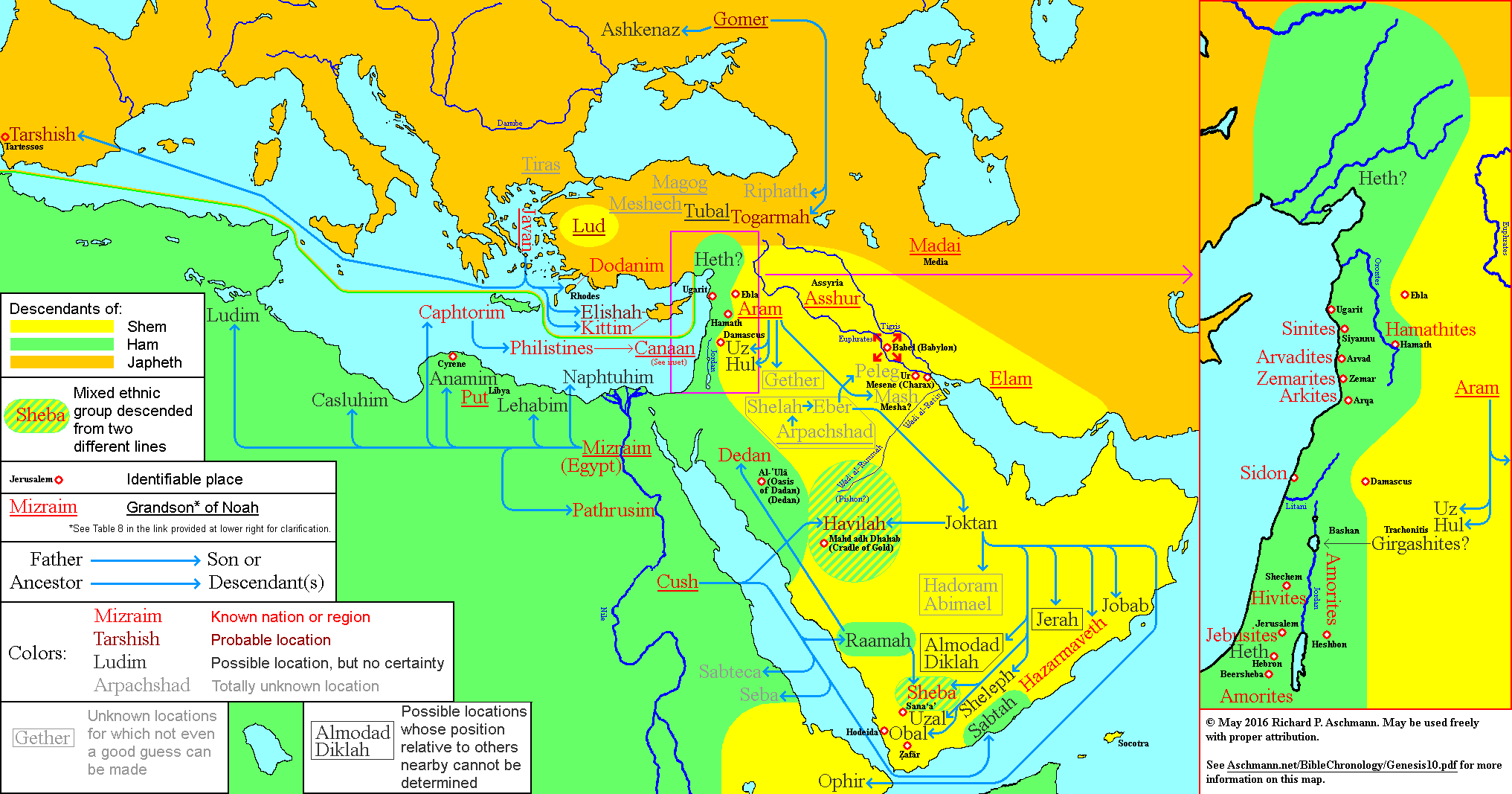 Image Caption: Map of Table of Nations locations for Shem, Ham, and Japheth by descendency. Source: Richard P. Aschmann, "The Genesis 10 Table of Nations and Y-Chromosomal DNA" (February 17, 2022) [https://aschmann.net/BibleChronology/Genesis10.pdf]
Plotting the descendency of families in Genesis 10 on a map of the ancient Near East shows a high correlation to relative geographical dispersion. This does not prove that Genesis 10 is either a record of genetic descendencies or of historical migrations alone, but it does suggest that the genealogist who compiled the list of nations was tracking people groups based on relative geographical distribution by clans, families, and groups.
Image Caption: Map of Table of Nations locations for Shem, Ham, and Japheth by descendency. Source: Richard P. Aschmann, "The Genesis 10 Table of Nations and Y-Chromosomal DNA" (February 17, 2022) [https://aschmann.net/BibleChronology/Genesis10.pdf]
Plotting the descendency of families in Genesis 10 on a map of the ancient Near East shows a high correlation to relative geographical dispersion. This does not prove that Genesis 10 is either a record of genetic descendencies or of historical migrations alone, but it does suggest that the genealogist who compiled the list of nations was tracking people groups based on relative geographical distribution by clans, families, and groups.
Ancient Semitic Language Locations
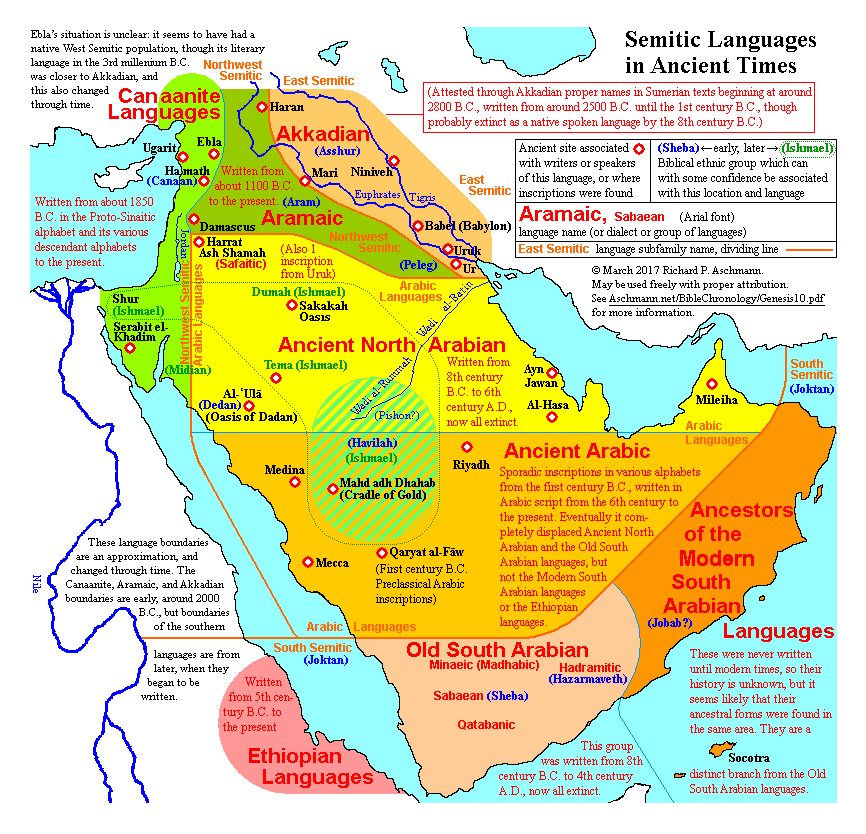 Image Caption: Map of ancient Semitic language locations. Source: Richard P. Aschmann, "The Genesis 10 Table of Nations and Y-Chromosomal DNA" (February 17, 2022) [https://aschmann.net/BibleChronology/Genesis10.pdf]
Plotting ancient Semitic language groups on a map shows how ancient socio-linguistic groups disbursed. While Genesis 10 is not a record of language groups per se, it stands to reason that language groupings would correlate to genetic groupings by clans and families.
Image Caption: Map of ancient Semitic language locations. Source: Richard P. Aschmann, "The Genesis 10 Table of Nations and Y-Chromosomal DNA" (February 17, 2022) [https://aschmann.net/BibleChronology/Genesis10.pdf]
Plotting ancient Semitic language groups on a map shows how ancient socio-linguistic groups disbursed. While Genesis 10 is not a record of language groups per se, it stands to reason that language groupings would correlate to genetic groupings by clans and families.
Opening Summary: Genesis 10:1
| א וְאֵלֶּה תּוֹלְדֹת בְּנֵי-נֹחַ שֵׁם חָם וָיָפֶת; וַיִּוָּלְדוּ לָהֶם בָּנִים, אַחַר הַמַּבּוּל. | 1 Now these are the generations of the sons of Noah: Shem, Ham, and Japheth; and unto them were sons born after the flood. |
Noah
Shem
Founded SUMER in Ubaid level (S.N. Kramer & Arno Poebel)
Ham
Egypt: K-HEM-ET Miautso tribe of China: have a lineage akin to NU-AH, LO-HAN (Ham), LO-SHEN (Shem), and JAH-PHU (Japheth)
Japheth
Sanskrit: DJAPATISHITA “chief of the race” Hindu Veda, 1400 BC: PRA-JAPATI / JYAPETI, with brothers SHARMA (Shem) and C’HARMA (Ham); cursed by SATYAURATA (Noah) since he laughed at his drunkenness
C’HARMA / KARMA? (caste system): In ancient India, Brahmans are light-skinned Aryans who despise dark-skinned Dravidians
Greek/Latin: IAPETOS = IU-PATER = JUPITER
Genesis 10:1 — Sons of Noah Opening
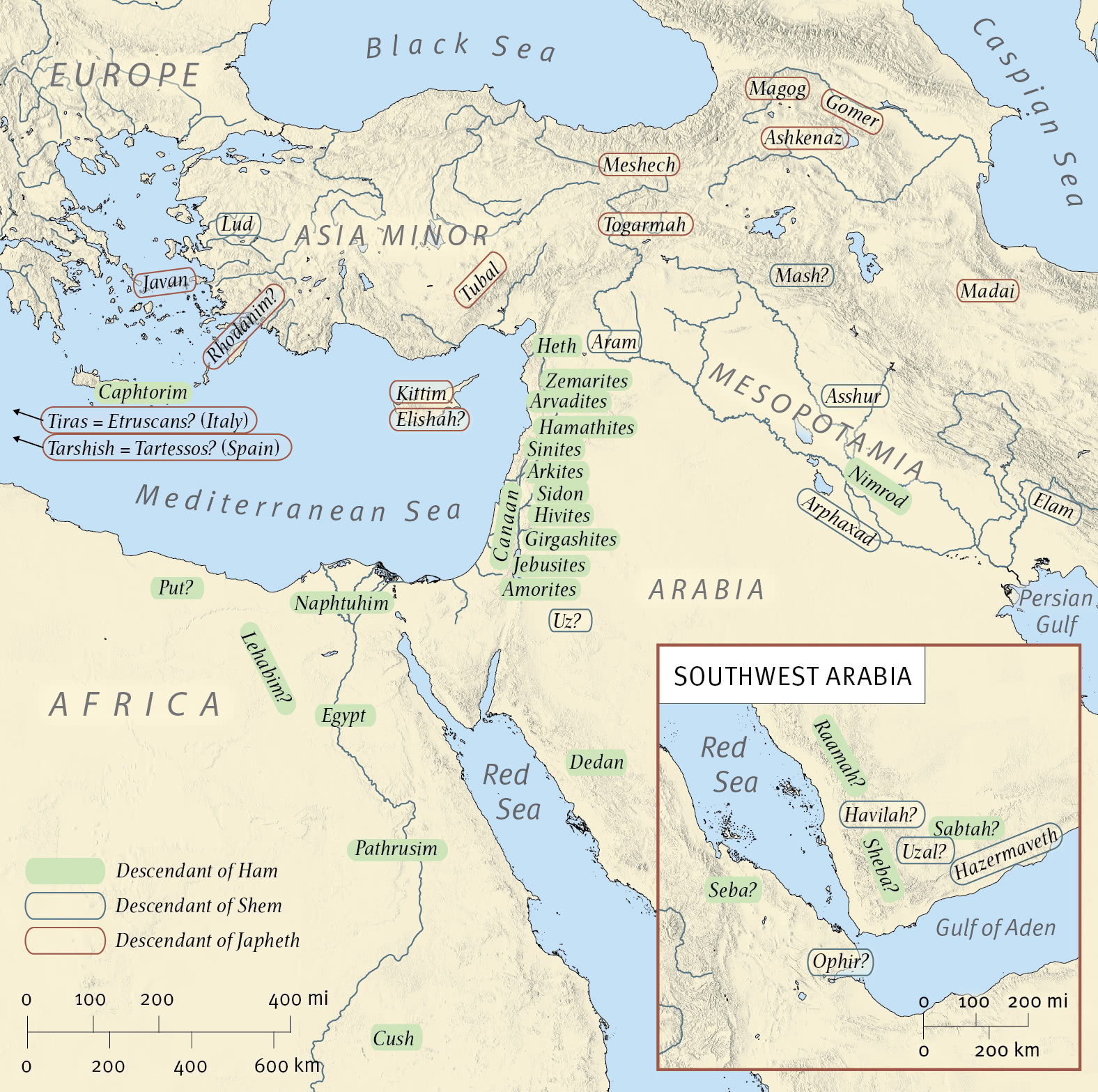 Image Caption: Map of Table of Nations. Source: Table of Nations (ESV Global Study Bible) [https://www.esv.org/resources/esv-global-study-bible/map-01-03/]
Mapping the location of nations mentioned in Genesis 10 (ca. 2200 BC) is at best an approximation, based on the findings of socio-linguistics and genetic history. Language groups and DNA haplogroups continued to mingle and migrate throughout their histories. For this reason, it's best to compare written sources and maps and to form an ecclectic synthesis of probable locations.
Image Caption: Map of Table of Nations. Source: Table of Nations (ESV Global Study Bible) [https://www.esv.org/resources/esv-global-study-bible/map-01-03/]
Mapping the location of nations mentioned in Genesis 10 (ca. 2200 BC) is at best an approximation, based on the findings of socio-linguistics and genetic history. Language groups and DNA haplogroups continued to mingle and migrate throughout their histories. For this reason, it's best to compare written sources and maps and to form an ecclectic synthesis of probable locations.
Shem
The father of all the Semitic nations. (Interpreter's Dictionary of the Bible (1962) 4:321. New Bible Dictionary (1972) 1175. Josephus, Antiquities l.vi.4. Matthew Poole, Commentary on the Holy Bible 3 vols (1685) 1:28)
Source: Bill Cooper, After the Flood [http://www.ldolphin.org/cooper/appen1.html]
Ham
One must reckon with DNA, paleontological, and socio-linguistic evidence for an 'out of Africa' hypothesis relating to the spread of humanity throughout Africa, Eurasia, and the American continents. Much evidence for humanity's dispersion predates the biblical account of a Mesopotamian origin of culture, as depicted in Genesis 1 to 11. Such mutually contextualizing attestations require of anthropologists and Bible readers a measure of humility before all the lines of evidence as to how God guided humans to 'be fruitful, multiply, and fill the Earth'. Such an approach mitigates against misinterpreting the biblical archetypes, on the one hand, and against misinterpreting the roles that nationalities play on the stage of history, on the other. A lesson may be learned from observing one European disposition toward the dispersion of Hamite nations among other regions, as Hodgen reports,
"Yt has observed that Cham, and his famely, were the only far Travellers, and Straglers into diverse unknowne countries, searching; exploring and sitting downe in the same; as also yt is said of his famely that what country soever the children of Cham happened to possesse, there beganne both the Ignoraunce of true godliness … and that no inhabited countryes cast forth greater multytudes, to raunge and stray into diverse remote Regions." Thus far the comments of one William Strachey, who added to these words in 1612 the following damning indictment, accusing Ham's posterity of instigating: "the ignoraunce of the true worship of God … the inventions of Heathenisme, and [the] adoration of falce godes and the Devill … "
Cited in M. Hodgen, Early Anthropology in the Sixteenth and Seventeenth Centuries (University of Pennsylvania, Philadelphia, 1971), p. 262. (Cf. Interpreter's Dictionary of the Bible (1962) 2:515. New Bible Dictionary (1972) 500. Josephus, Antiquities 1.vi.2. Matthew Poole, Commentary on the Holy Bible 3 vols (1685) 1:27)
Source: Bill Cooper, After the Flood [http://www.ldolphin.org/cooper/appen2.html]
Japheth
The father of all the Indo-European peoples, it would be surprising indeed if his name had gone unremembered among them. As it is, we find that the early Greeks worshipped him as Iapetos or Iapetus, whom they regarded as the son of heaven and earth, the father of many nations. Likewise, in the ancient Sanskrit vedas of India he is remembered as Pra-Japati, the sun and ostensible Lord of Creation. As time went by, his name was further corrupted, being assimilated into the Roman pantheon as Iupater (Jupiter). None of these names are of Greek, Indian or Latin origin, but are merely corruptions of the original name of Japheth. Both the early Irish Celts and the early Britons traced the descent of their royal houses from Japheth, as did also the early Saxons who corrupted his name to Sceaf,--pr. 'sheaf' or 'shaif'. (Interpreter's Dictionary of the Bible (1962) 2:802. New Bible Dictionary (1972) 599. Josephus, Antiquities 1.vi.1. Matthew Poole, Commentary on the Holy Bible 3 vols (1685) 1:26)
Source: Bill Cooper, After the Flood [http://www.ldolphin.org/cooper/appen3.html]
Genesis 10:2 — Sons of Japheth Opening
| ב בְּנֵי יֶפֶת--גֹּמֶר וּמָגוֹג, וּמָדַי וְיָוָן וְתֻבָל; וּמֶשֶׁךְ, וְתִירָס. | 2 The sons of Japheth: Gomer, and Magog, and Madai, and Javan, and Tubal, and Meshech, and Tiras. |
Japheth
Gomer
Akk: GIMIRRYA, defeated by Esarhaddon (677 BC)
Armenian: GAMIR Herodotus, Strabo, Plutarch: GIMERI
Black Sea coast: CIMMERIA / CRIMEA
Migrated west: GAULS (France), GALATI (Spain), CELTAE (Britain). GOMER = CYMRIC CELTS = CYMRU (Wales) GOMERLAND = CUMBERLAND CUMBRIA = CAMBRIA
Magog
Akk: MAT GUGI
Pliny the Elder: MAGOG
Migrated to N of Caucasus: Scythians (Ukraine, Southern Russia, Kazakhstan), Mongolia, Aleuts, Eskimos, America
Madai
Josephus, (Ant. 1.6.1): Madai = MEDIA.
Capital: Ecbatana (Herodotus)
Strabo: MATIANI north of Black Sea
Herodotus, Histories 5:9: migrated to Ukraine
Javan
Josephus (Ant. 1.6.1.): Javan = Ionia
Akk: YAWANI / YAMAN / YAVANU
Persia: YAUANA
Hindu: YAVANNA
Greek: IONIA
Tubal
Josephus: THOBELITES
Akk: TUBLA / TABALI / TABAL
Greek: TIBERANI
Hittite Empire fell 1200 BC: TIBALI moved in.
BULGARI = BULGARIA
TOBOLSK = TBILISI in Russia
Meshech
Josephus: MOSOCH
Akk: MUSKAA
Herodotus: Migrated N of Armenia
Xenophon: near Black Sea
Migrated to Russia: MOSKVA = MOSCOW
Tiras
Josephus (Ant. 1.6.1) & Jerusalem Talmud (Megillah 10a): Tiras = Thrace (Thracians).
Greek: TYRESENOI
Crete: TIRYNS?
Minoan culture?
Macedonia / Yugoslavia
Genesis 10:2 — Sons of Japheth: 'Sonless' Nations
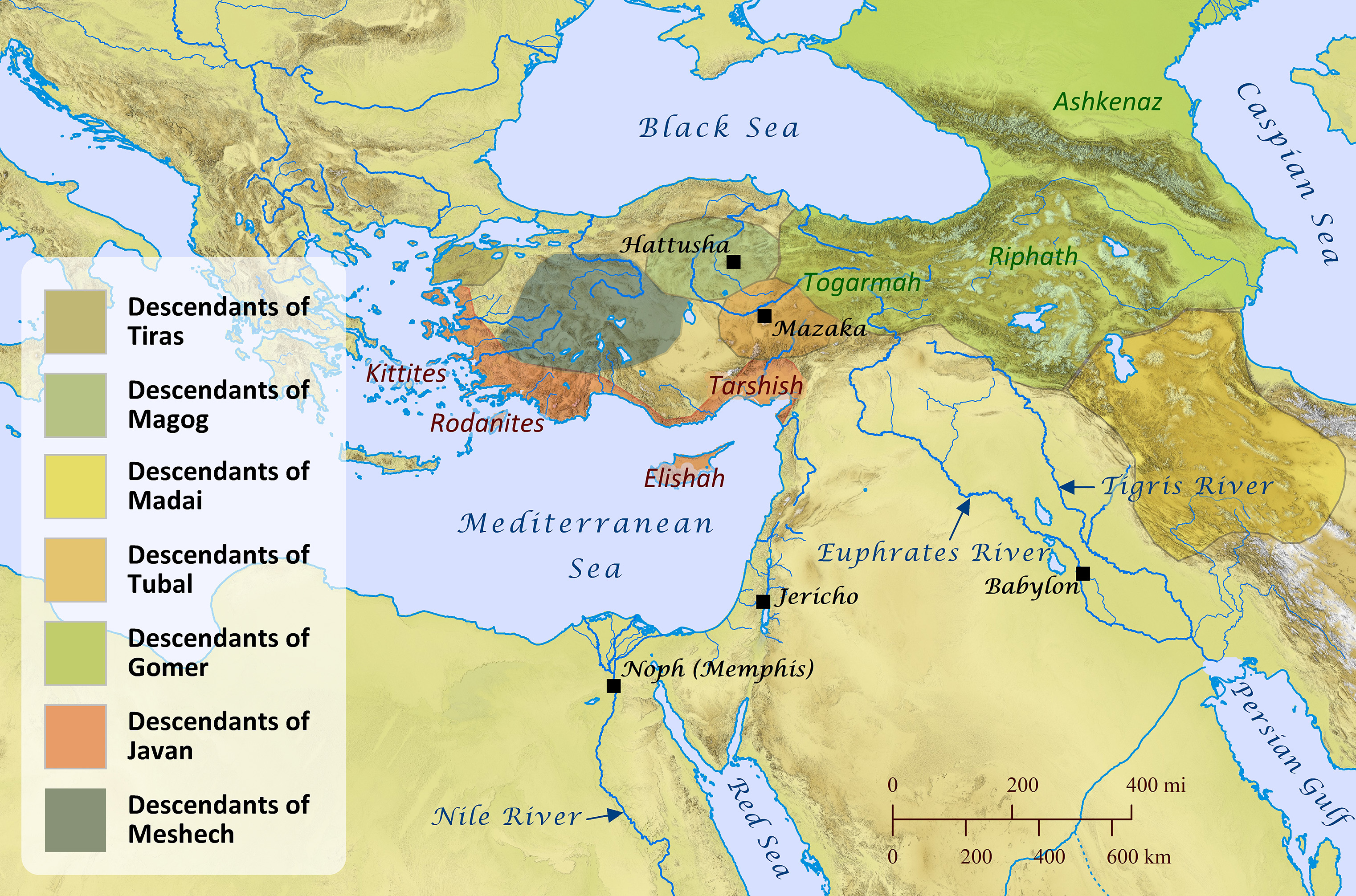 Image Caption: Map of Japheth Nations. Source: Table of Nations: Japheth (Bible Mapper) [https://biblemapper.com/blog/images/hi-res/TableOfNationsJapheth_high.jpg]
A conservative estimation of the locale of the people groups mentioned for Japheth would have them in the regions of Anatolia, extending from the Caucus Mountains in the east to the Aegean Islands in the west. Many of these people groups continued to migrate northward into Eurasia and westward into Europe.
Image Caption: Map of Japheth Nations. Source: Table of Nations: Japheth (Bible Mapper) [https://biblemapper.com/blog/images/hi-res/TableOfNationsJapheth_high.jpg]
A conservative estimation of the locale of the people groups mentioned for Japheth would have them in the regions of Anatolia, extending from the Caucus Mountains in the east to the Aegean Islands in the west. Many of these people groups continued to migrate northward into Eurasia and westward into Europe.
Magog
Magogites were later known to the Greeks as Scythians, according to Josephus. However, in the subsequent history of the peoples of Ashchenaz, who are later identified as Scythians (Gk. Skythai, and Assyr. Askuza), it is more likely that Magogites had been assimilated into the peoples of Ashchenaz, forming only a part of the Scythian hordes. Irish Celts trace their lineage from Japheth through Magog. (Interpreter's Dictionary of the Bible (1962) 3:226. New Bible Dictionary (1972) 'Gog and Magog' 480-1. Josephus, Antiquities 1.vi.1. Matthew Poole Commentary on the Holy Bible 3 vols (1685) 1:26)
Madai
The Madaeans are better known as the Medes. The Assyrians recorded the name as Amada; the Greeks as the Medai; and the Old Persian inscriptions speak of them as the Mada. The earliest surviving reference to the Medes is found in secular documents, such as the inscriptions of Shalmaneser III, king of Assyria from ca. 858–824 BC, which tell us that he invaded the land of the Medes to plunder their horses. Both Strabo and Herodotus confirm that the Medes were of Indo-European (Japhetic) origin, and that their language was of this group. After 631 BC, the Medes joined with the people of Askuza (or the Ashchenazim) and those of Gomer (the Cimmerians) in an attempt to throw off the Assyrian yoke. (Interpreter's Dictionary of the Bible (1962) 3:220. New Bible Dictionary (1972) 'Medes' 801-2. Josephus, Antiquities 1.vi.1. Matthew Poole Commentary on the Holy Bible 3 vols (1685) 1:26)
Tubal
The descendants of Tubal are attested in the inscriptions of Tiglath-pileser I, king of Assyria ca. 1100 BC, who refers to them as the Tabali whose area of settlement (Tabal) was adjacent to that of Tegarama. Josephus recorded the name of Tubal's descendants as the Thobelites, who were later known as the Iberes. In Josephus' day, the Romans called their land Iberia. It covered what is now the state of Georgia, whose capital still bears the name Tbilisi. After crossing the Caucasus mountains, this people migrated north-east, giving their name to the river Tobol and to the city of Tobolsk. (Interpreter's Dictionary of the Bible (1962) 4:717. New Bible Dictionary (1972) 'Meshech' 811. Josephus, Antiquities 1.vi.1)
Meshech
The descendants of Meshech are often spoken of in association with those of Tubal. The Assyrians mention Tabal and Musku, while Herodotus writes of the Tiberanoi and Moschoi. An early reference to the peoples of Meshech is in an inscription of ca. 1200 BC that tells us how they overran the Hittite kingdom. An inscription of Tiglath-pileser I of Assyria from ca. 1100 BC says the Mus-ka-a-ia were able to put into the field an army of 20,000 men. The activities of this people are also reported by Tukulti-ninurta II, Ashurnasipal II, Sargon and Shalmaneserr III, the latter of whom refers to them as the Mushki. Josephus knew them as the Mosocheni (LXX Mosoch), also known as the Cappadocians. Later writers have pointed out that the name of Meshech is preserved in the tribal name of the Muscovites of Russia, after whom Moscow is named (Russian 'Moskva' is akin to Assyrian 'Musku'). (Interpreter's Dictionary of the Bible (1962) 3:357. New Bible Dictionary (1972) 811. Josephus, Antiquities 1.vi.l. Matthew Poole Commentary on the Holy Bible 3 vols (1685) 1:26)
Tiras
Merenptah of Egypt, who reigned in the 13th century BC, provides the earliest reference to the people of Tiras, recording their name as Tursha (or Turusha) and describing them as invaders from the north. The Greeks knew them as the Tyrsenoi, a nation of marauding pirates. Josephus identifies them as a tribe known to the Romans as the Thirasians (that is, Thracians). Tiras was venerated by his descendants as Thuras (i.e., Thor), the god of war. The river Athyras is named after him, and it is not unlikely that the Etruscans owe to him their name and descent. The city of Troas (Troy) also appears to perpetuate his name, as does the Taurus mountain range. (Interpreter's Dictionary of the Bible (1962) 4:652. New Bible Dictionary (1972) 1283. Josephus, Antiquities 1.vi.1. Matthew Poole Commentary on the Holy Bible 3 vols (1685) 1:26)
Source: Bill Cooper, After the Flood [http://www.ldolphin.org/cooper/appen3.html]
Genesis 10:3 — Sons of Japheth: Gomer & Sons
| ג וּבְנֵי, גֹּמֶר--אַשְׁכְּנַז וְרִיפַת, וְתֹגַרְמָה. | 3 And the sons of Gomer: Ashkenaz, and Riphath, and Togarmah. |
Japheth
Gomer
Magog
Madai
Javan
Tubal
Meshech
Tiras
Ashkenaz
Akk: ASGUZA
Homer, Iliad 2:863: ASKAENI near Lake ASCENIA (Turkey)
Migrated to S. Russia: SCY THAI (Herodotus)
Migrated west: Islands of ASCANIA (Scandinavia).
SAKI (Strabo) moved from Caspian Sea to Germany (SAKASENOI = SAXONS)
Riphath
Riphaeans = Raphlagomians = Paphlagonians (Josephus)
Migrated to Russia & west to Finn-Ugric peoples: Finns, Lapps, Hungarians
Togarmah
Akk: TIL-GARIMMU
Hittite: TEGARAMA
Moses Chorenensis 1:4: Armenia came from ‘the son of TARGOM’
Strabo: TOGARMAH
Josephus: PHRYGIANS
Migrated to Turkistan
Genesis 10:3 — Sons of Japheth: Gomer Nations
Gomer
Image Caption: Map of Japheth Nations. Source: Table of Nations: Japheth (Bible Mapper) [https://biblemapper.com/blog/images/hi-res/TableOfNationsJapheth_high.jpg]
Gomer was the founder of the Cimmerians who settled originally on the shores of the Caspian Sea. They were later driven away by the Elamites. At the time of the Babylonian Exile, the Jews knew them as the tribes that dwelt in the 'uppermost parts of the north' (Ezekiel 38:6). The Assyrians referred to them as the Gimirraya. Esarhaddon (681-668 BC) records his defeat of the Gimirrai; whilst King Ashurbanipal tells us in his records of the Cimmerian invasion of Lydia in the days of the Lydian king Gugu around the year 660 BC. (Interpreter's Dictionary of the Bible (1962) 2:440. New Bible Dictionary (1972) 481; Josephus, Antiquities 1.vi.1.)
Descent of Miautso People (in China)
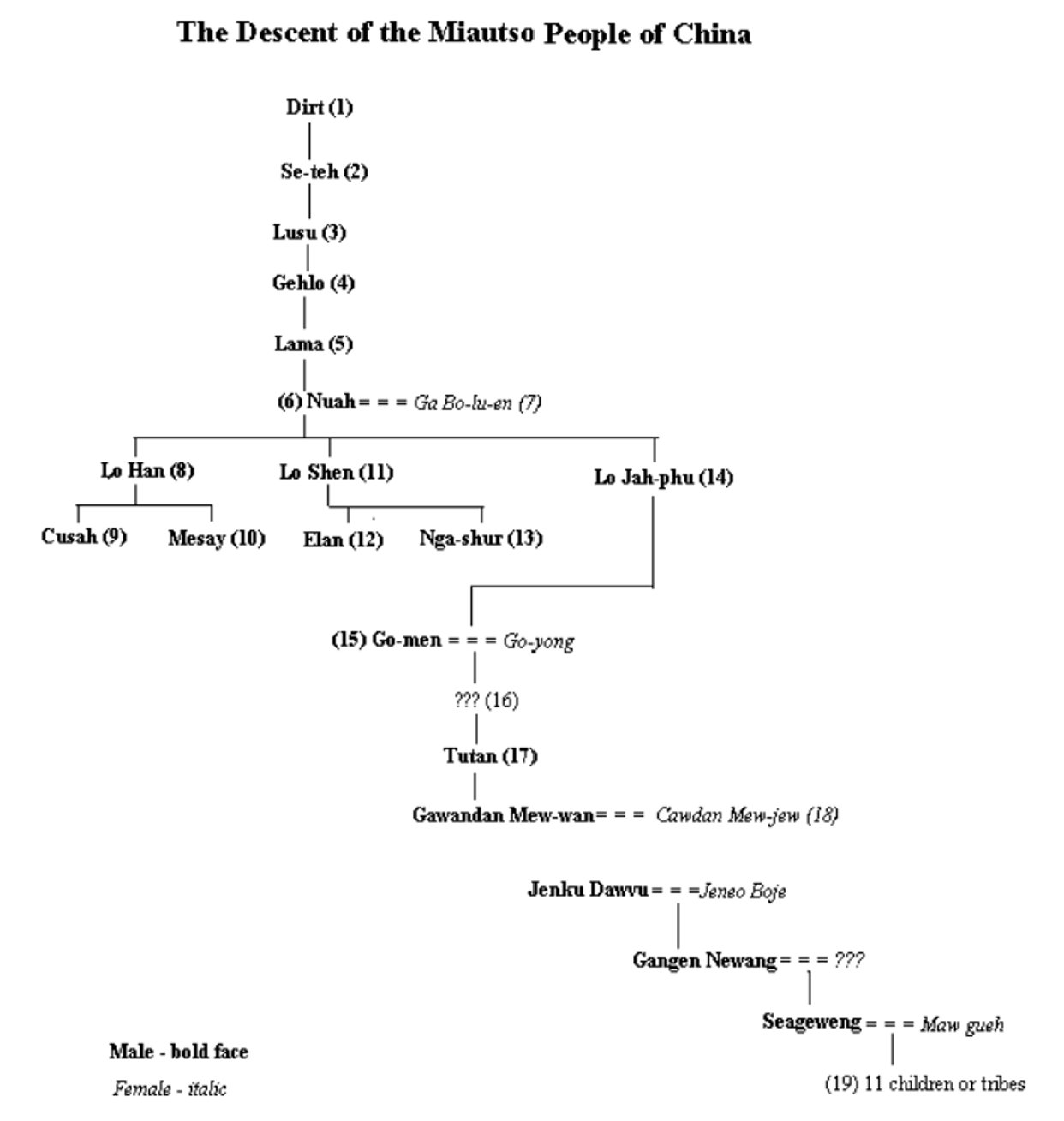 Image Caption: Descent of the Miautso people in China. Source: Bill Cooper, "The Descent from Japheth of the Miautso People of China" (Lambert Dolphin Library) [https://www.ldolphin.org/cooper/appen12.html]
The Miautso people do not claim descent from the Chinese people. Early Chinese-based names for the Miautso use various transcriptions: Miao, Miao-tse, Miao-tsze, Meau, Meo, mo, Miao-tseu etc. …
Image Caption: Descent of the Miautso people in China. Source: Bill Cooper, "The Descent from Japheth of the Miautso People of China" (Lambert Dolphin Library) [https://www.ldolphin.org/cooper/appen12.html]
The Miautso people do not claim descent from the Chinese people. Early Chinese-based names for the Miautso use various transcriptions: Miao, Miao-tse, Miao-tsze, Meau, Meo, mo, Miao-tseu etc. …
Some suggest the Miao (especially the Miao-Hunan) have their origins in southern China but have DNA traces from the Northeast people of China. Recent DNA samples of Miao males contradict this theory. The White Hmong have 25% C, 8% D, & 6% N-Tat yet they have the least contact with the Han population.
Sources:
- Miao people (Wikipedia) [https://en.wikipedia.org/wiki/Miao_people]
- Wen Bo; Li Hui; Gao Song; Mao Xianyun; Gao Yang; Li Feng; Zhang Feng; He Yungang; Dong Yongli; Zhang Youjun; Huang Wenju; Jin Jianzhong; Xiao Chunjie; Lu Daru; Chakraborty, Ranajit; Su Bing; Deka, Ranjan; Jin Li (2005). "Genetic Structure of (H)mong-Mien Speaking Populations in East Asia as Revealed by mtDNA Lineages". Oxford Journal of Molecular Biology and Evolution. 22 (3): 725–734. doi:10.1093/molbev/msi055. PMID 15548747
- Cai Xiaoyun; Qin Zhendong; Wen Bo; Xu Shuhua; Wang Yi; Lu Yan; Wei Lanhai; Wang Chuanchao; Li Shilin; Huang Xingqiu; Jin Li; Li Hui (2011). "Human Migration through Bottlenecks from Southeast Asia into East Asia during Last Glacial Maximum Revealed by Y Chromosomes" (xls). PLoS ONE. 6 (8) e24282. Table 1. doi:10.1371/journal.pone.0024282.s003. PMC 3164178. PMID 21904623
Celtic Migration
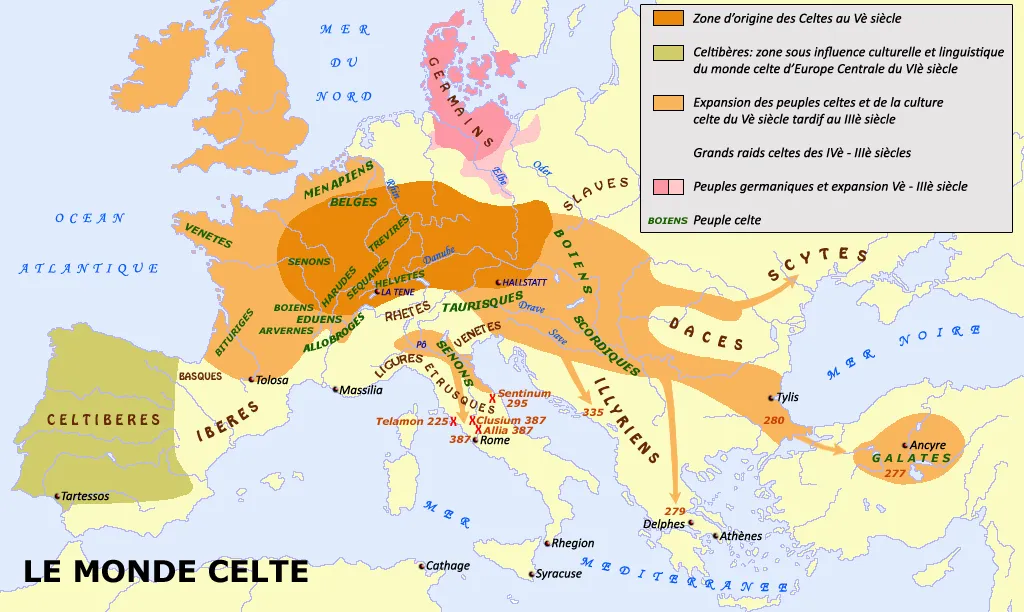 Image Caption: Map showing the migration of the Celts from ancient Cimmerians. Source: Le Celtes (Chewbii.com, July 9, 2015) [https://chewbii.com/les-celtes/]
The Cimmerians invaded Europe from the northeast and southeast. Northern Cimmerians become the Germani (Germans) and the Belgae (Belgians). Southern Cimmerians became the Galatians in Turkey, the Helvetii and Boii in northern Italy and Switzerland, and the Gauls (French) in France. Later movements of the Cimmerians, and possibly some Scythian immigrants became the Catuvellani of England and the Gaels of Ireland and Scotland. Perhaps also Crimea got its name from ancient Cimmerians who settled there.
Image Caption: Map showing the migration of the Celts from ancient Cimmerians. Source: Le Celtes (Chewbii.com, July 9, 2015) [https://chewbii.com/les-celtes/]
The Cimmerians invaded Europe from the northeast and southeast. Northern Cimmerians become the Germani (Germans) and the Belgae (Belgians). Southern Cimmerians became the Galatians in Turkey, the Helvetii and Boii in northern Italy and Switzerland, and the Gauls (French) in France. Later movements of the Cimmerians, and possibly some Scythian immigrants became the Catuvellani of England and the Gaels of Ireland and Scotland. Perhaps also Crimea got its name from ancient Cimmerians who settled there.
Ashchenaz
The descendants of Ashchenaz first settled in what is today Armenia, although in later Jewish writings he was associated (with his father Gomer) with the Germanic races. Hence, Germanic Jews are still known as Ashkenazim. More immediately, the Assyrians tell us in their inscriptions of the Askuza, a tribe who allied themselves with the Mannai in a revolt of the 7th century BC, an event that is also mentioned in the Old Testament (Jeremiah 51:27). Indeed, it is in this statement that Jeremiah incidentally confirms the identity of the Ashkenazim with the Askuza. This name, the Askuza of the Assyrian records, later became the Skythai (Scythians) of Herodotus. Other early sources confirm their place of settlement to be the area later known as Pontus and Bythinia, where the peoples of Ashchenaz gave their name to the lake and harbour of Ascanius, and to the land of Ascania. Josephus tells us that they were subsequently known to the Greeks as the Rheginians. (Interpreter's Dictionary of the Bible (1962) 1:254. New Bible Dictionary (1972) 96. Josephus, Antiquities 1.vi.1. Matthew Poole Commentary on the Holy Bible 3 vols (1685) 1:26)
Riphath
His descendants gave their name to the Riphaean mountains, which early cosmographers thought of as constituting the then northernmost boundary of the earth. Pliny, Melo and Solinus record the name of Riphath as that of the Riphaci, Riphaces and Piphlataci who were later known to history as the Paphlagonians, the descent and identification of which is confirmed by Josephus. (Interpreter's Dictionary of the Bible (1962) 4:100. Josephus, Antiquities 1.vi.1. Matthew Poole Commentary on the Holy Bible 3 vols (1685) 1:26)
Togarmah
His earliest descendants settled in Armenia. We know from certain Hittite documents that in the 14th century BC, the then region of Tegarama, which lay between Carchemish and Haran, was sacked by the 'enemy from Isuwa', i.e. the enemy from beyond the Euphrates. The records of both Sargon II and Sennacherib mention the city of Til-gari-manu, the capital of Kammanu which lay on the border of Tabal. Til-gari-manu lay some thirty miles due east of present-day Malatya (it is known today as Gürün, anciently Gauraena), and was not finally destroyed until the year 695 BC. It was after the destruction of Til-gari-manu that the descendants of Togarmah became lost in obscurity. In line with the Assyrian policy of that time, the survivors were uprooted and transported to other lands within the Assyrian empire. The name was given as Thrugramma by Josephus. (Interpreter's Dictionary of the Bible (1962) 4:662. New Bible Dictionary (1972) 1285. Josephus, Antiquities 1.vi.1. Matthew Poole Commentary on the Holy Bible 3 vols (1685) 1:26)
Source: Bill Cooper, After the Flood [http://www.ldolphin.org/cooper/appen3.html]
Genesis 10:4 — Sons of Japheth: Javan & Sons
| ד וּבְנֵי יָוָן, אֱלִישָׁה וְתַרְשִׁישׁ, כִּתִּים, וְדֹדָנִים. | 4 And the sons of Javan: Elishah, and Tarshish, Kittim, and Dodanim. |
Japheth
Gomer
Magog
Madai
Javan
Tubal
Meshech
Tiras
Elishah
Josephus: Aeolians
Amarna Tablets: ALASIA
Greek: ELIS = HELLAS = HELLENES
One tribe MILYAES migrated east: Himalayas, Malayasia, Malaca, Molucca Islands, Malayu (Sumatra)
Tarshish
Phoenician: 𐤕𐤓𐤔𐤔 (Tršš)
Hebrew: תַּרְשִׁישׁ (Taršiš)
Koine Greek: Θαρσεῖς (Tharseis)
Kittim
Cyprus & Macedonia
Dodanim
Rhodes & Dardanians = Dardanelles (Troy)
Genesis 10:4 — Sons of Japheth: Javan Nations
Javan
Image Caption: Map of Japheth Nations. Source: Table of Nations: Japheth (Bible Mapper) [https://biblemapper.com/blog/images/hi-res/TableOfNationsJapheth_high.jpg]
The name of Javan appears as Iamanu in Assyrian documents, which say they engaged the Assyrians in a major sea battle during the reign of King Sargon 11 (721-705 BC). The Archaemenian inscriptions refer to them as the Yauna. Homer tells us in the Iliad that Iawones (Hebrew Iawan) was the progenitor of the Ionians (Gk. Iones), while the Hebrews knew the Greeks as the Jevanim (Iewanim). Pre-Islamic Arab cosmographers gave the name as Yuban. (Interpreter's Dictionary of the Bible (1962) 2:805. New Bible Dictionary (1972) 600. Josephus, Antiquities 1.vi.1. Matthew Poole Commentary on the Holy Bible 3 vols (1685) 1:26)
Elishah
Elishah was the ancestor of the Aeolians, and his name is referred to throughout Greek history and mythology. Two Greek cities were named after him, Elis and Elissus. Likewise, an entire area was named Elias in his memory. His name lies behind the origin of the term Hellas, and there is every reason to believe that the name is perpetuated as the Greek paradise, the Elysian Fields. The Armana tablets referred to his descendants as the Alashia, the Hittites knew them as the Alasiya, and the Egyptians as A-ra-sa. Josephus rendered the name as Elisa. The name also appears in Ugaritic inscriptions. (Interpreter's Dictionary of the Bible (1962) 2:92. New Bible Dictionary (1972) 366, Josephus, Antiquities 1.vi.l. Matthew Poole Commentary on the Holy Bible 3 vols (1685) 1:26)
Tarshish
The peoples of Tarshish (Tartesis or Tartessos) are thought to have settled in Spain, in southwest Andalusia near the Guadalquivir River. The region was famous for mineral wealth, including silver, iron, tin, and lead, which matches the specific metals the Bible says Tarshish traded with Tyre. The Mediterranean Sea was once called the Sea of Tarshish, and the Phoenicians built a class of sea vessel called a ship of Tarshish. (It was in one of these that Jonah sailed from Joppa in the 8th century BC.) Phoenician inscriptions found in Sardinia, dating to the 9th century BC, mention Tarshish without providing a clear identification of geographical location. Josephus records the name as Tharsus and says it used to be the name for Cilicia, whose chief city was Tarsus; yet, this identification is unconfirmed elsewhere. (Interpreter's Dictionary of the Bible (1962) 4:517. New Bible Dictionary (1972) 1239-40. Josephus, Antiquities 1.vi.1. Matthew Poole Commentary on the Holy Bible 3 vols (1685) 1:26)
Kittim
Kittim is a collective name of a people who are spoken of in Old Phoenician inscriptions as the kt or kty, who settled on the island of Cyprus. They were to give their name to the ancient Cypriot city of Kition (modern-day Larnaka). The Romans preserved the name when they named the city Citium, and Josephus gave the name as Cethimus. (Interpreter's Dictionary of the Bible (1962) 3:40-1. Josephus, Antiquities 1.vi.1. Matthew Poole Commentary on the Holy Bible 3 vols (1685) 1:26)
Dodanim
Dodanim also is a collective name of a people descended from Dodan, who were known to the Greeks as the Dardani, the Dardanians of Asia Minor. They settled initially around the area of Troy whose coastal regions are known to this day as the Dardanelles. The founder of this people was deified by his descendants and worshipped under the name of Jupiter Dodonaeus (a mingling of the names of Japheth and Dodan). The propagators of this cult built the city of Dodona as the chief seat of his worship. Egyptian records refer to the drdny who were allied to the Hittites at the battle of Kadesh. The early Britons trace their descent from Dardanus. There may be a confluence with the people of Rhodes, since in the Aramaic script there is easily a confusion between the spelling of דודנים (Dodanim) and רודנים (Rhodanim). (Interpreter's Dictionary of the Bible (1962) 1:861. New Bible Dictionary (1972) 321. Matthew Poole Commentary on the Holy Bible 3 vols (1685) 1:26)
Source: Bill Cooper, After the Flood [http://www.ldolphin.org/cooper/appen3.html]
Genesis 10:5 — Sons of Japheth Closing
| ה מֵאֵלֶּה נִפְרְדוּ אִיֵּי הַגּוֹיִם, בְּאַרְצֹתָם, אִישׁ, לִלְשֹׁנוֹ--לְמִשְׁפְּחֹתָם, בְּגוֹיֵהֶם. | 5 From these were the isles of the nations divided among their lands, every one by his tongue, by their families, among their nations. |
Without naming Japheth, this verse identifies Japheth as that family of nations who distinctly occupied אִיֵּי הַגּוֹיִם 'the isles of the nations'. No people group besides that of Japheth is as characteristically a people settled among the islands and coastlands of the sea: Anatolia, Cyprus, Crete, Greece and the Aegean islands.
It's also telling to note that the Table of Nations compiler's aim was to subdivide nations 'among their lands, every one by his tongue, by their families, among their nations' (cf. 10:20; 10:31). There is thus both a linguistic strategy of segregation and a segregation based on claims of familial descent. By modern standards, these would be both socio-linguistic and tribo-genetic forms of evidence for humanity's migratory history. As interpreters of history through nature, culture, and biblical revelation, such lines of evidence (linguistic and genetic) may be found to contextualize and inform each other. This should be expected. Since God is the one who reveals truth in all its forms, all truth is God's truth. Our task is to interpret carefully and respectfully.
Genesis 10:6 — Sons of Ham Opening
| ו וּבְנֵי, חָם--כּוּשׁ וּמִצְרַיִם, וּפוּט וּכְנָעַן. | 6 And the sons of Ham: Cush, and Mizraim, and Put, and Canaan. |
Ham
Cush
Egypt: KOS/KOSH
Akk: KUSHU
Josephus (Ant. 1:6:2): ‘Ethiopians … called CUSHITES’
Book of Sothis (time of Amenhotep III, 1391-1351 BC): ‘The Ethiopians, removing from the River Indus, settled in Egypt.’
Vast Eurasian Migration Back to Ethiopia ca. 2500 BC
Mizraim
Ugaritic (14 Cent. BC): MSRM
Amarna Tablets (1385-1360 BC): MISRI
Akk: MUSUR
Babylonian: MUSRI
Egypt: MASRI
Put
PUT = Lybia
Egypt: PUT/PUNT
Persia: PUTA
Canaan
Egypt: KANAAN/KNNW
Phoenicia & Greece: K’NA’AN
Akk: KINNAHU
Hurrian (1400 BC): KINAHNE
Genesis 10:6 — Sons of Ham: 'Sonless' Nation Put
Put
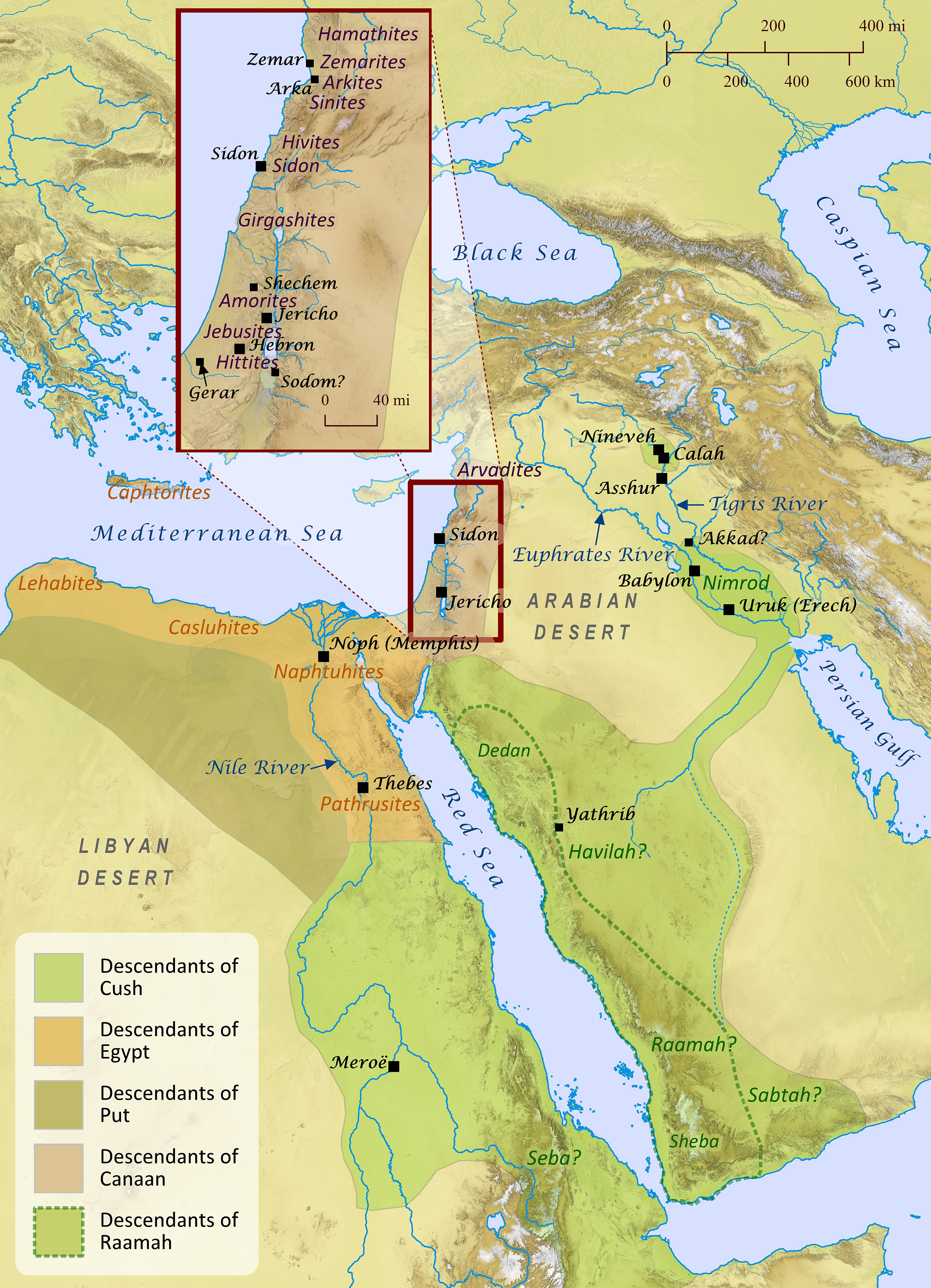 Image Caption: Map of Ham Nations. Source: Table of Nations: Ham (Bible Mapper) [https://biblemapper.com/blog/images/hi-res/TableOfNationsHam_high.jpg]
The country in which the descendants of Put settled is well known to us from Egyptian records, which render the name Put or Punt. (Josephus calls it Phut.) It is spoken of as closely associated with Egypt, and its close geographical proximity to Egypt is confirmed by an inscription from the archives of Darius the Great, king of Persia from 522 to 486 BC. Here the land of Puta is shown as lying in proximity to Cyrenaica, on the North African coast, west of Egypt (today called Lybia). This land was known as Puta to the Babylonians and as Putiya in Old Persian inscriptions. (Interpreter's Dictionary of the Bible (1962) 3:971. New Bible Dictionary (1972) 1066. Josephus, Antiquities 1.vi.2. Matthew Poole Commentary on the Holy Bible 3 vols (1685) 1:27)
Image Caption: Map of Ham Nations. Source: Table of Nations: Ham (Bible Mapper) [https://biblemapper.com/blog/images/hi-res/TableOfNationsHam_high.jpg]
The country in which the descendants of Put settled is well known to us from Egyptian records, which render the name Put or Punt. (Josephus calls it Phut.) It is spoken of as closely associated with Egypt, and its close geographical proximity to Egypt is confirmed by an inscription from the archives of Darius the Great, king of Persia from 522 to 486 BC. Here the land of Puta is shown as lying in proximity to Cyrenaica, on the North African coast, west of Egypt (today called Lybia). This land was known as Puta to the Babylonians and as Putiya in Old Persian inscriptions. (Interpreter's Dictionary of the Bible (1962) 3:971. New Bible Dictionary (1972) 1066. Josephus, Antiquities 1.vi.2. Matthew Poole Commentary on the Holy Bible 3 vols (1685) 1:27)
Source: Bill Cooper, After the Flood [http://www.ldolphin.org/cooper/appen2.html]
Genesis 10:7 — Sons of Ham: Cush & Sons
|
ז
וּבְנֵי כוּשׁ--סְבָא וַחֲוִילָה, וְסַבְתָּה וְרַעְמָה וְסַבְתְּכָא; וּבְנֵי רַעְמָה, שְׁבָא וּדְדָן. |
7
And the sons of Cush: Seba, and Havilah, and Sabtah, and Raamah, and Sabteca; and the sons of Raamah: Sheba, and Dedan. |
Ham
Cush
Mizraim
Put
Canaan
Seba
India / Sri Lanka: SIBAE / SHIVA
Havilah
E. Africa: AVALITAIE / AVALIS
Sabtah
SIBATHENS / SOMOLIS
Raamah
Sheba
Dedan
Sabteca
Nimrod
= king ENMERKAR?
= god MIMURDA / NIMURUD?
(Lagash Temple)
Genesis 10:7 — Sons of Ham: Cush Nations
Cush
Image Caption: Map of Ham Nations. Source: Table of Nations: Ham (Bible Mapper) [https://biblemapper.com/blog/images/hi-res/TableOfNationsHam_high.jpg]
Josephus writes: 'Time has not at all hurt the name of Cush; for the Ethiopians, over whom he reigned, are even at this day, both by themselves and by all men in Asia, called Cushites.' The name of Cush (originally rendered Chus in Josephus) is preserved in Egypt's hieroglyphic inscriptions as Kush, these records referring to the country that lay between the second and third cataracts of the Nile. This same land was later known as Nubia (Ethiopia). Additional information on this location is gleaned from the records of Esarhaddon, king of Assyria (681-668 BC), who tells us that he made himself king of Musur, of Paturisi, and Cush. Some have claimed also that the name of Cush was likewise perpetuated in that of the Babylonian city of Kish, one of the earliest cities to be built after the Flood. Kish was the capital of the Kassites who established the Akkad Dynasty. (Interpreter's Dictionary of the Bible (1962) 1:751. New Bible Dictionary (1972) 284. Josephus, Antiquities 1, vi.2. Matthew Poole Commentary on the Holy Bible 3 vols (1685) 1:27)
Sebah
Sebah founded the nation that was known to later history as the Sabaeans. Strabo writes of their city of Sabai along with its harbour of Saba (same spelling as in Josephus), which lay on the west coast of the Arabian peninsula. (Interpreter's Dictionary of the Bible (1962) 4:260. Josephus, Antiquities 1.vi.2)
Havilah
Havilah was the eponymous progenitor of the Hamitic tribe of Havilah. (There were two tribes of Havilah, one of them Semitic in origin.) His descendants settled on the east coast of Arabia looking out onto the Persian Gulf. Their land was known to the pre-Islamic writers as Hawlan, and to Josephus as Evilas. Kautsch renders the name as Huwailah, and confirms their settlement on the east coast of Arabia. (Interpreter's Dictionary of the Bible (1962) 2:537. New Bible Dictionary (1972) 506. Josephus, Antiquities 1.vi.2. Matthew Poole Commentary on the Holy Bible 3 vols (1685) 1:29)
Sabta
Josephus records the name of Sabta's descendants as the Sabateni or Sabathes. Ptolemy knew them as the Saptha, and Pliny called them the Messabathi. They settled on the eastern side of the Arabian peninsula. Sabta's name is also preserved in that of the ancient city of Shabwat (modern Sabota), the capital of the Hadramaut (Hazarmaveth). (Interpreter's Dictionary of the Bible (1962) 4:146. New Bible Dictionary (1972) i112. Josephus, Antiquities 1.vi.2. Matthew Poole Commentary on the Holy Bible 3 vols (1685) 1:27)
Raamah
We know from the inscriptions of ancient Sheba that Raamah's descendants settled near to the land of Havilah, and to the east of Ophir. They are known from other sources to have traded with the children of Zidon in the city of Tyre. Ptolemy agreed with the LXX in the name Ragma, which Josephus rendered Ragmas. There is still a place called Raamah near Ma'in in south-west Arabia. (Interpreter's Dictionary of the Bible (1962) 4:1. New Bible Dictionary (1972) 1072. Josephus, Antiquities 1.vi.2. Matthew Poole Commentary on the Holy Bible 3 vols (1685) 1)
Sheba
Minaean inscriptions from the north Yemen, and which date to the 9th century BC, tell us that Sheba was that kingdom's southern neighbor. The land of Sheba is also known to us from Assyrian inscriptions of the 8th century BC. Sheba was famous as the Land of Spices (there were four 'spice kingdoms'--Minaea, Kataban, and Hadramaut), and we know from the vast archaeological ruins, some of whose walls still stand some 60 feet above the desert sands, that the land was extremely fertile, being watered by ingenious irrigation systems controlled by a great dam that once spanned the river Adhanat. In the year 542 BC, the dam collapsed after more than a thousand years of service, an event that is recalled in the Koran and described there as a judgment of God upon the people.(Interpreter's Dictionary of the Bible (1962) 4:311-2. New Bible Dictionary (1972) 1171. Josephus, Antiquities 1.vi.4. Matthew Poole Commentary on the Holy Bible 3 vols (1685) 1:27)
Dedan
The posterity of Dedan are known to have traded with the Phoenicians. Identified from various cuneiform inscriptions, their main place of settlement was the city that is known today as Al-ula, and which lies some 70 miles southwest of modern Taima. (Interpreter's Dictionary of the Bible (1962) 1:812. New Bible Dictionary (1972) 305)
Sabtecha
Sabtecha is identified by Josephus as the Sabactens or Sabactas, Sabtecha's descendants appear to have settled in southern Arabia, the modern Yemen. (Interpreter's Dictionary of the Bible (1962) 4:146. New Bible Dictionary (1972) 1112. Josephus, Antiquities 1.vi.2. Matthew Poole Commentary on the Holy Bible 3 vols (1685) 1:27)
Source: Bill Cooper, After the Flood [http://www.ldolphin.org/cooper/appen2.html]
Genesis 10:8-12 — Sons of Ham: Nimrod Polemic
| ח וְכוּשׁ, יָלַד אֶת-נִמְרֹד; הוּא הֵחֵל, לִהְיוֹת גִּבֹּר בָּאָרֶץ. | 8 And Cush bore Nimrod; he began to be a mighty one in the earth. |
| ט הוּא-הָיָה גִבֹּר-צַיִד, לִפְנֵי יְהוָה; עַל-כֵּן, יֵאָמַר, כְּנִמְרֹד גִּבּוֹר צַיִד, לִפְנֵי יְהוָה. | 9 He was a mighty hunter before YHWH; therefore, it is said: 'Like Nimrod a mighty hunter before YHWH.' |
| י וַתְּהִי רֵאשִׁית מַמְלַכְתּוֹ בָּבֶל וְאֶרֶךְ וְאַכַּד וְכַלְנֵה, בְּאֶרֶץ שִׁנְעָר. | 10 And the beginning of his kingdom was Babel, and Erech, and Akkad, and Calneh, in the land of Shinar. |
| יא מִן-הָאָרֶץ הַהִוא יָצָא אַשּׁוּר; וַיִּבֶן אֶת-נִינְוֵה, וְאֶת-רְחֹבֹת עִיר, וְאֶת-כָּלַח. | 11 Out of that land went forth Asshur and built Nineveh, and Rehoboth-Ir, and Calah, |
| יב וְאֶת-רֶסֶן, בֵּין נִינְוֵה וּבֵין כָּלַח--הִוא, הָעִיר הַגְּדֹלָה. | 12 and Resen between Nineveh and Calah--that is, the great city. |
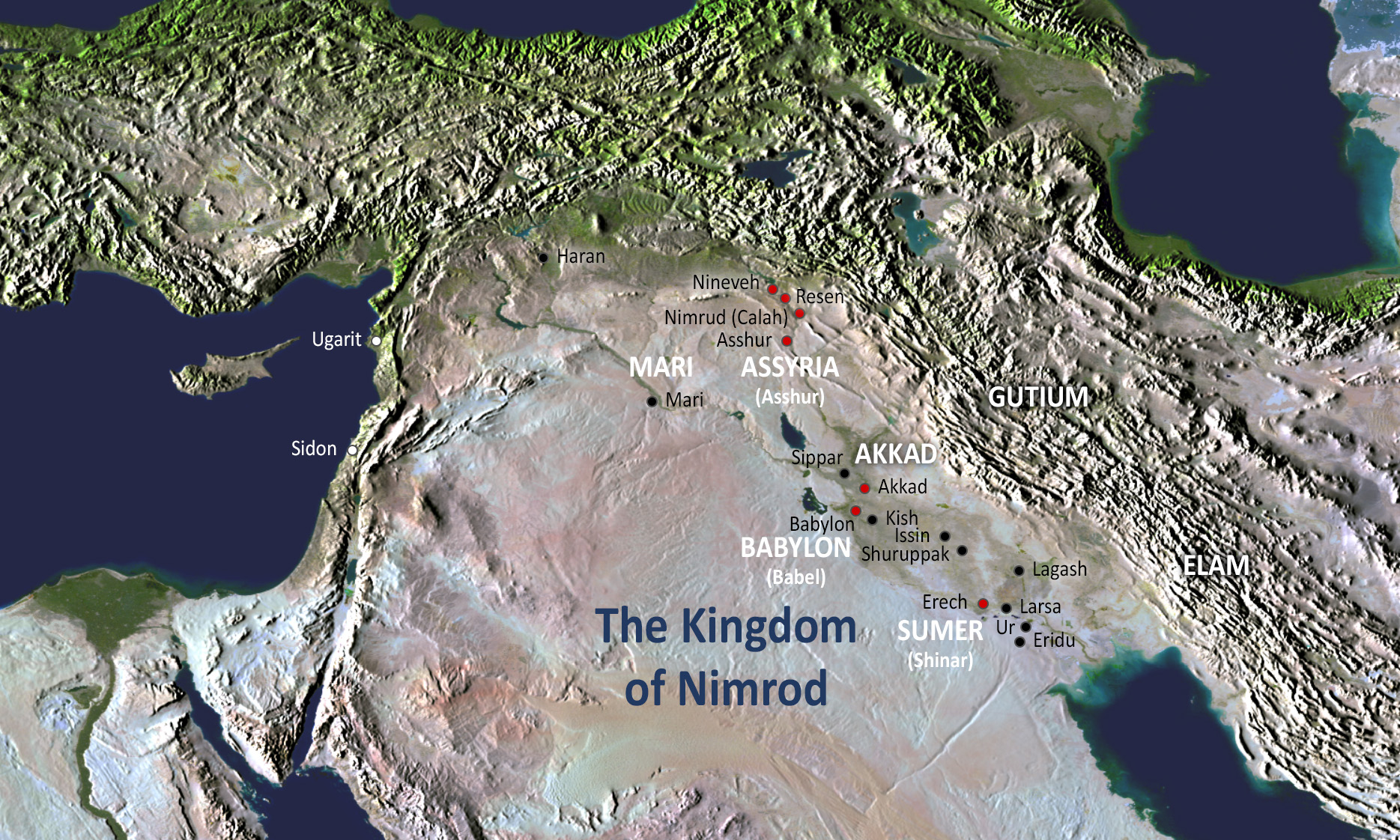 Image Caption: Cities of the Kingdom of Nimrod. Source: Satellite Relief Map of Middle East (Wikimedia) [https://upload.wikimedia.org/wikipedia/commons/c/cd/Satellite_relief_map_of_Middle_East.png]
E.A. Speiser probably rightly identified Nimrod’s 'Cush' with the Iranian people called 'Kassites', originally from the Zagros Mountains, who came to rule Babylonia from the 16th to the 12th centuries BC.
Image Caption: Cities of the Kingdom of Nimrod. Source: Satellite Relief Map of Middle East (Wikimedia) [https://upload.wikimedia.org/wikipedia/commons/c/cd/Satellite_relief_map_of_Middle_East.png]
E.A. Speiser probably rightly identified Nimrod’s 'Cush' with the Iranian people called 'Kassites', originally from the Zagros Mountains, who came to rule Babylonia from the 16th to the 12th centuries BC.
Legend says that the man later known as Sargon of Akkad was born in the town of Azipiranu on the Euphrates. At birth, his priestess mother allegedly hid him in a basket of rushes, which she set afloat on the river. The basket floated to Kish, where he was adopted by Aqqi ('water-drawer'), who was a gardener and mentor for young Sargon. Eventually, Sargon became cup-bearer (prime minister) to Urzababa, king of Kish. Later, Sargon himself became king of Kish, then upon moving his capital to Akkad, he became 'King of Sumer and Akkad'. Sargon of Akkad adopted the throne-name Šarru-kîn (hence, Sargon), which in Eastern-Semitic (Akkadian) means “the true (or legitimate) King,” suggesting that some doubted his regal legitimacy (so Yigal Levin, Nimrod, Mighty Hunter and King).
Sargon is the first known Semitic-speaking Mesopotamian ruler. He adapted Sumerian cuneiform to extend the influence of his own Akkadian language. He ruled over a vast Mesopotamian region for 56 years. According to the Sumerian King List, after the flood, kingship came down from heaven and was granted to the city of Kish.
Because of parallel attributions, is tempting to identify biblical Nimrod with Sargon or his grandson Naram-Sin. Both traditions describe a reign in Sumer/Shinʿar, an empire builder extending rule from Akkad and Babylon north to Assyria. Both traditions depict a ruler of extraordinary prowess. Both traditions regard this king as the first postdiluvian to wield imperial power.
The Table of Nations depicts Nimrod as a descendant of Noah, though the eratic form of Nimrod's account marks it as a later polemic accretion. Shinʿar appears in both the Table of Nations 'Nimrod excursis' (Genesis 10:8-12) and in the Tower of Babel account (Genesis 11:1-9), which suggests that Nimrod, the builder of the tower, is the archetype of the rebel king — indeed, the verb from which נִמְרוֹד 'Nimrod' derives, מרד, means 'to rebel'. Nimrod is the archetypal 'Rebel' — the antithesis of the anointed kingship YHWH will establish in the course of salvation history.
Writing in 1876, George Smith tells us that: 'Nearly thirteen hundred years before the Christian era, one of the Egyptian poems likens a hero to the Assyrian chief Kazartu, 'a great hunter … and it has already been suggested that the reference here is to the fame of Nimrod. A little later, 1100 to 800 BC, we have in Egypt many persons named Nimrod, showing a knowledge of the mighty hunter there.' (George Smith, Chaldean Genesis, p. 313). Nimrod was undoubtedly the most notorious man in the ancient world who is credited with instigating the Great Rebellion at Babel, and of founding astrology and even human sacrifice. Moreover, there is much evidence to suggest that he himself was worshipped from the earliest times. His name was perpetuated in those of Nimurda, the Assyrian god of war; Marduk, the Babylonian king of the gods; and the Sumerian deity Amar-utu. His image was likewise incorporated early in the Chaldean zodiac as a child seated on his mother's lap, and both mother and child were worshipped, she as the Queen of Heaven, and he as her erstwhile sacrificial son. Nimrod was also worshipped by the Romans under the name of Bacchus, this name being derived from the Semitic bar-Cush, meaning the son of Cush. A mountain not far from Ararat, has been called Nimrud Dagh (Mount Nimrod) from antiquity, and the ruins of Birs Nimrud bear the remains of what is commonly reputed to be the original Tower of Babel. The Caspian Sea was once called the Mar de Bachu, or Sea of Bacchus, as witnessed by the map appearing in Sir Walter Raleigh's History of the World, published in 1634. One of the chief cities of Assyria was named Nimrud, and the Plain of Shinar, known to the Assyrians as Sen'ar and the site of the Great Rebellion, was itself known as the Land of Nimrod. (Interpreter's Dictionary of the Bible (1962) 3:551. New Bible Dictionary (1972) 888. Josephus, Antiquities 1.vi.2. Matthew Poole Commentary on the Holy Bible 3 vols (1685) 1:27)
Source: Bill Cooper, After the Flood [http://www.ldolphin.org/cooper/appen2.html]
Genesis 10:13-14 — Sons of Ham: Mitzraim & Sons
| יג וּמִצְרַיִם יָלַד אֶת-לוּדִים וְאֶת-עֲנָמִים, וְאֶת-לְהָבִים--וְאֶת-נַפְתֻּחִים. | 13 And Mizraim bore Ludim, and Anamim, and Lehabim, and Naphtuhim, |
| יד וְאֶת-פַּתְרֻסִים וְאֶת-כַּסְלֻחִים, אֲשֶׁר יָצְאוּ מִשָּׁם פְּלִשְׁתִּים--וְאֶת-כַּפְתֹּרִים. {ס} | 14 and Pathrusim, and Casluhim--whence went forth the Philistines--and Caphtorim. {S} |
Ham
Cush
Mizraim
Put
Canaan
Ludim
Anamim
Lehabim
Naphtuhim
Pathrusim
Casluhim
Philistines
PELESHET = Sea Peoples of Medinet Habu (Egypt)
Caphtorim
Egypt: KAPHTARA = Crete = Minoans (2000-1450 BC)
Genesis 10:13-14 — Sons of Ham: Mitzraim Nations
Mitzraim
Image Caption: Map of Ham Nations. Source: Table of Nations: Ham (Bible Mapper) [https://biblemapper.com/blog/images/hi-res/TableOfNationsHam_high.jpg]
A collective name, these people settled in Egypt. Modern Israelis still use the name for that country; it is preserved as Msrm in the Ugaritic inscriptions; as Misri in the Amarna tablets; and in the Assyrian and Babylonian 4 records as Musur and Musri respectively. Modern Arabs still know it as Misr. Josephus (rendering the name Mesraites) relates a curious episode that he called the Ethiopic War, incident that was apparently well-known throughout ancient world. According to Josephus, some six or sevev nations descended from the Mizraim were destroyed, clearly a major conflict that would have had profound far-reaching repercussions in the world of those times. Josephus lists those nations as the Ludim; the Anamim; the Lehabim; the Naphtuhim; the Pathrusim; the Cashuhim; and the Caphtorim. (Interpreter's Dictionary of the Bible (1962) 3:409. New Bible Dictionary (1972) 833. Josephus, Antiquities 1.vi.2. Matthew Poole Commentary on the Holy Bible 3 vols (1685) 1:27)
Ludim
Seemingly known in later records as the Lubim (which Josephus rendered Ludicim) this people settled on the north coast of Africa and gave their name to the land of Lybia. They are known to have provided Egypt on more than one occasion with mercenary troops. The records that tell us this give the Ludim's name as Lebu. Otherwise, Josephus records their destruction, or rather defeat, in the Ethiopic War. (Interpreter's Dictionary of the Bible (1962) 3:178-9. New Bible Dictionary (1972) 755. Josephus, Antiquities 1.vi.2. Matthew Poole Commentary on the Holy Bible 3 vols (1685) 1:28)
Anamim
Few occurrences of this name can now be found in the surviving records. This may be due to the devastations of the Ethiopic War. However, the Assyrian king, Sargon II, does tell us in his inscriptions of the land of the A-na-mi which lay adjacent to that of Kaptara. Josephus rendered the name Enemim. (Interpreter's Dictionary of the Bible (1962) 1:124. Josephus, Antiquities 1. vi.2. Matthew Poole Commentary on the Holy Bible 3 vols (1685) 1:28)
Lehabim
The Egyptians recorded this name as 'rbw', although it is uncertain where they settled. Some authorities (including Josephus who renders the name Lybyos) give Lybia (Libya) as their country. This people were, however, destroyed in the Ethiopic War. (Interpreter's Dictionary of the Bible (1962) 3:110. New Bible Dictionary (1972) 728. Josephus, Antiquities 1. vi.2. Matthew Poole Commentary on the Holy Bible 3 vols (1685) 1:28)
Naphtuhim
This people are known to have settled in Nile delta and the western parts of Egypt, where early cords refer to them as the p't'mhw--literally, 'they of the marshland.' Their name also appears as Na-patob-im in the same records. Josephus records their destruction in the Ethiopic War. (Interpreter's Dictionary of the Bible (1962) 3:510. New Bible Dictionary (1972) 865. Matthew Poole Commentary on the Holy Bible 3 vols (1685) 1:28)
Pathrusim
The people of this name migrated to Upper Egypt, where the Egyptians recorded their name as the p't'r or Ptores. The district of Pathros thus bears their name Esarhaddon, king of Assyria from 681-668 BC, records hi conquest of the Paturisi, thus showing that this particular tribe at least were not totally destroyed in the Ethiopic War as asserted by Josephus, who renders the name Phethrosim (IDB 3:676. New Bible Dictionary (1972) 938. Josephus, Antiquities 1.vi.2)
Casluhim
The precise whereabouts of their country is uncertain, although the book of Genesis does record that the Philistines came from this people. Some cite Crete as their possible place of settlement, which, if true, would make the Ethiopic War of Josephus a truly international conflict, as he records the destruction of the Casluhim in that war. This, however, only serves to make Crete a most unlikely place for their settlement, the northern areas of Egypt being a far more reasonable proposition (but see 18 and 19 and Map 3). Josephus gives their name as the Chesloim. (Interpreter's Dictionary of the Bible (1962) 1:541. New Bible Dictionary (1972) 201. Josephus, Antiquities 1.vi.3. Matthew Poole Commentary on the Holy Bible 3 vols (1685) 1:28)
Philistim
Better known to us as the Philistines, they were known to the Assyrians as the Palashtu and the Pilisti, and to the Greeks as the Palastine--hence the later name of Palestine. After the Assyrian conquests of the 8th century BC, the Philistines effectively disappear as a coherent nation. It is currently but wrongly believed that the Philistines did not appear until the 13th century BC, and that they are to be identified as the 'Sea Peoples' of Egyptian literature. But this view is erroneous. The Genesis record states emphatically that the Philistim occupied parts of Canaan as early as the time of Abraham, and far from implying that their place of origin was Crete, as currently taught, it is much more likely to have been northern Egypt (but see 19 and Map 3). (Interpreter's Dictionary of the Bible (1962) 3:791-5. New Bible Dictionary (1972) 'Philistines' 988-991. Josephus, Antiquities 1.vi.2. Matthew Poole Commentary on the Holy Bible 3 vols (1685) 1:28)
Caphtorim
Some confusion has reigned in recent years over the question of the geographical location of Caphtorim. This is mainly due to modernist efforts to identify Caphtor as Crete. This would allow the assertion that the Philistines were the Sea Peoples of the 13th century BC, and that the Genesis record therefore errs when it speaks of the Philistines as the 19th century BC contemporaries of Abraham. In opposition to this view, however, the Genesis record gives the common sense and verifiable place of the Caphtorim's settlement as Egypt, or Mizraim where the name of the Caphtorim was rendered Keftiu in a record that is conventionally dated to ca 2200 BC. Genesis tells us that the Caphtorim were descended from the Mizraim, and, through the absence of any qualifying remarks, leaves us with the strong implication that the Caphtorim therefore dwelt on the mainland of Egypt or North Africa either amongst, or in close proximity to, their forebears the Mizraim. Only the descendants of Japheth are said to have occupied the isles of the sea, e.g. Cyprus or Crete et al, whereas this qualification is entirely absent with either the Semitic or Hamitic race. The early Cretans, we know, were not a Hamitic people, but rather were Indo-European in race, language and culture, which confirms their descent from Japheth (and not Ham) as provided in the Genesis account. Furthermore, Josephus relates the involvement and subsequent defeat of the Caphtorim (whom he names the Cephtorim) in the Ethiopic War, a conflagration that was confined to the borders of Egypt and Ethiopia, and which did not, as far as we know, involve the isles of the sea. Moreover, Jeremiah 47:4 describes the Philistines as the 'remnant of the country of Caphtor', thus implying that by his own day the Caphtorim were a depleted nation. There is also strong evidence of a direct etymological link between the ai-Kaphtor of the Old Testament and the Aiguptos of Greek literature, Aiguptos being merely the archaic form of the western name for Egypt. That Caphtor's descendants were mainland dwellers is also confirmed in the Assyrian inscriptions in which they are named as the Kaptara; and in the Ugaritic inscriptions as the 'kptr'. Later, Egyptian records speak of the 'kftyw' or Kaphtur, a term that was used in relation to Phoenicia, not Crete. Intriguingly, the Septuagint translates the name as Kaphtoriim in Genesis 10:14; whereas in the book of Deuteronomy (2:23) the name is rendered Kappadokes or Cappadocians. Likewise, the Latin Vulgate gives the rendering Caphtorim in Genesis 10:14, thus following the original Hebrew; whereas in Deuteronomy 2:23 it follows the Greek Septuagint in the rendering Cappadoces and Cappadocia--Cappadocia, of course, referring to mainland Asia Minor. Thus, to identify the Caphtorim as early Cretans is clearly untenable. (Interpreter's Dictionary of the Bible (1962) 1:534. New Bible Dictionary (1972) 199. Josephus, Antiquities 1.vi.3. Matthew Poole Commentary on the Holy Bible 3 vols (1685) 1:28)
Source: Bill Cooper, After the Flood [http://www.ldolphin.org/cooper/appen3.html]
Genesis 10:15-18 — Sons of Ham: Canaan & Sons
| טו וּכְנַעַן, יָלַד אֶת-צִידֹן בְּכֹרוֹ--וְאֶת-חֵת. | 15 And Canaan bore Zidon his firstborn, and Heth; |
| טז וְאֶת-הַיְבוּסִי, וְאֶת-הָאֱמֹרִי, וְאֵת, הַגִּרְגָּשִׁי. | 16 and the Jebusite, and the Amorite, and the Girgashite; |
| יז וְאֶת-הַחִוִּי וְאֶת-הַעַרְקִי, וְאֶת-הַסִּינִי. | 17 and the Hivite, and the Arkite, and the Sinite; |
| יח וְאֶת-הָאַרְוָדִי וְאֶת-הַצְּמָרִי, וְאֶת-הַחֲמָתִי; וְאַחַר נָפֹצוּ, מִשְׁפְּחוֹת הַכְּנַעֲנִי. | 18 and the Arvadite, and the Zemarite, and the Hamathite; and afterward were the families of the Canaanite spread abroad. |
Ham
Cush
Mizraim
Put
Canaan
Zidon
Heth
Jebusite
Amorite
Girgashite
Hivite
Arkite
Sinite
Arvadite
Zemarite
Hamathite
Genesis 10:15-18 — Sons of Ham: Canaan Nations
Canaan
Image Caption: Map of Ham Nations. Source: Table of Nations: Ham (Bible Mapper) [https://biblemapper.com/blog/images/hi-res/TableOfNationsHam_high.jpg]
The posterity of Canaan settled in the land that was later to be given to Israel. At the time of the Israelite conquest of Canaan, the population consisted of all the tribes descended from Canaan. Both Sanchuniathon and Phylo of Byblos confirm the fact that the Canaanites derived their name from their founder. The Greeks and Phoenicians rendered the name Kna'an; the Egyptians knew it as Kn'nw and Kyn'nw; the Assyrians rendered the name Kinnahu; and the Hurrians described certain dyed cloths as Kinahne or Canaanite cloth. In spite of their Hamitic descent, however, the Canaanites spoke a Semitic language. (Interpreter's Dictionary of the Bible (1962) 1:494. New Bible Dictionary (1972) 183-6. Josephus, Antiquities 1.vi.2. Matthew Poole Commentary on the Holy Bible 3 vols (1685) 1:27)
Zidon
Zidon settled, with his descendants, on the Mediterranean coast of Canaan, where his name is still perpetuated in the modern-day city of Sidon. Originally known as Zidonians, his posterity were later known as Phoenicians. They are known to us from many and various inscriptions of the old world, the Akkadians, for example, rendering the name Sidunu, and the Armana tablets as Sa'idunu. Josephus adopted this spelling when he rendered the name Sidonius. (Interpreter's Dictionary of the Bible (1962) 4:343-5. New Bible Dictionary (1972) 'Sidon' 1184-5. Josephus, Antiquities 1.vi.2. Matthew Poole Commentary on the Holy Bible 3 vols (1685) 1:28)
Heth
Heth was the progenitor of the Hittite nation, whose name was known to the Assyrians as the Khatti. The Hittites were apparently the first nation to smelt iron on any appreciable scale. The Armana tablets contain letters that were sent between the Hittite emperor Subbiluliuma and Amenhotep IV of Egypt. Rameses II tells us how he engaged the Hittites in what was the earliest recorded battle involving massed battle chariots. This was the famous battle of Kadesh, and it appears that the Hittites got the better of the Egyptian forces. Heth's name was perpetuated in the Hittite capital of Hattushash, modern Boghazkoy in Turkey. (Interpreter's Dictionary of the Bible (1962) 2:597. New Bible Dictionary (1972) 'Hittites' 528-9. Matthew Poole Commentary on the Holy Bible 3 vols (1685) 1:28)
Jebusite
The posterity of Jebus (whom Josephus knew as Jebuseus) settled in the mountainous regions of Judea where, due to their strong and natural fortifications they were able to withstand the armies of Israel. The chief city of the Jebusites came later to be known as Jerusalem, the Urusalimmu of the Armana tablets. (Interpreter's Dictionary of the Bible (1962) 2:807. New Bible Dictionary (1972) 601-2. Josephus, Antiquities 1.vi.2. Matthew Poole Commentary on the Holy Bible 3 vols (1685) 1:28)
Amorite
Known to the Sumerians as the Martu, and to the Akkadians as the Ammurru, the Amorite people settled in the land of Canaan. They appear to have initially adopted a nomadic way of life, although they were soon to organise themselves into a very powerul and aggressive nation. Indeed, the Amorites later came to conquer Babylonia, subsequently producing one the most famous of Babylonian kings, Hammurabi, whose name perpetuates the designation Annurru. Josephus the name as Amorreus. (Interpreter's Dictionary of the Bible (1962) 1:115. New Bible Dictionary (1972) 31-2. Josephus, Antiquities 1.vi.2. Matthew Poole Commentary on the Holy Bible 3 vols (1685) 1:28)
Girgashite
The name of the Girgashites has been discovered in the Ugaritic inscriptions as 'grgs' and 'bngrgs', in other words Girgash and the sons of Girgash. They are also known to us in Hittite documents as the Karkisa or Qaraqisha; and in Egyptian records as the Kirkash. They settled to the east of the river Jordan, between Galilee and the Dead Sea, and their descendants are probably to be identified with the Gadarenes of the NT. Josephus rendered the name Gergesus. (Interpreter's Dictionary of the Bible (1962) 2:399. New Bible Dictionary (1972) 471. Josephus, Antiquities 1.vi.2. Matthew Poole Commentary on the Holy Bible 3 vols (1685) 1:28)
Hivite
Known to the ancient Greeks as the Heuaios, and to Josephus as Eueus, the Hivite people moved from Canaan to the foothills of Lebanon during the Israelite conquest under Joshua. King Solomon was later to use Hivites as builders. (Interpreter's Dictionary of the Bible (1962) 2:615. New Bible Dictionary (1972) 529. Josephus, Antiquities 1.vi.2. Matthew Poole Commentary on the Holy Bible 3 vols (1685) 1:28)
Arkite
The Arkite people come to our notice in the inscriptions of Shalmaneser II and Tiglath-pileser III, both kings of Assyria, and both of whom describe the Arkites as 'rebellious'. The Arkites were known also to the Egyptians and are mentioned in the Armana tablets as the Irkata. They were known for their worship of Astarte. Their city is known to this day as Tell-Arqa, a place known to Thutmose III of Egypt as Arkantu. Josephus calls it Arucas, and it was known to the Romans as Caesari Libani. (Interpreter's Dictionary of the Bible (1962) 1:226. New Bible Dictionary (1972) 82. Josephus, Antiquities 1.vi.2. Matthew Poole Commentary on the Holy Bible 3 vols (1685) 1:28)
Sinite
The Sinite name is still to be found in the modern-day towns of Nahr as-Sinn and Sinn addarb, which are both in close proximity to Arqa. The Phoenicians knew the Sinites as the Usnu; the Assyrians called them the Usana and Siannu; and the Ugaritic tablets refer to them as the 'sn'. Strabo called their town Sinna, and Heironymous rendered it civitas Sini (which Josephus gave as Sineus).(Interpreter's Dictionary of the Bible (1962) 4:379. New Bible Dictionary (1972) 1194. Josephus, Antiquities 1.vi.3. Matthew Poole Commentary on the Holy Bible 3 vols (1685) 1:28)
Arvadite
The Arvadite people settled on the island that bore their founder's name, Arvad. Today it is called Ruad and lies north of the bay of Tripoli about two miles out to sea. The Arvadites were famed in the old world for their skilful seamanship, drawing for this even the grudging admiration of the Assyrians. Later, the Arvadites were to play an important part in the conquests of Alexander the Great. The Arvadites were known in the Armana tablets as the Arwada, to the Akkadians as the Aruda, and the Armana tablets as Aruadi. Josephus renders the name Arudeus. (Interpreter's Dictionary of the Bible (1962) 1:242. New Bible Dictionary (1972) 93. Josephus, Antiquities 1.vi.2. Matthew Poole Commentary on the Holy Bible 3 vols (1685) 1:28)
Zemarite
The posterity of Zemar were known to the Assyrians as the Simirra, and to the Egyptians as the Sumur. The name is still perpetuated in the modern city of Sumra, just north of Tripoli. (Interpreter's Dictionary of the Bible (1962) 4:950. New Bible Dictionary (1972) 1357-8. Matthew Poole Commentary on the Holy Bible 3 vols (1685) 1:28)
Hamathite
The city where the Hamathite people settled lay on the Orontes, and was named after their forebear, Hamath. Sargon II of Assyria tells us how he conquered the city, and it was at Hamath that Nebuchadnezzar defeated the Egyptian armies in 605 BC. The city was known to the Akkadians as Amatu, to the Egyptians as Hmtu, and to the Arabs as Hamat. The Greeks and Romans subsequently knew the city as Epiphaneia, although today it has reverted to its ancient name, Hamah. In 853 BC the men of Hamath were able to successfully defeat Assyrian advances in the west by mobilizing an army of no less than 63,000 foot soldiers, 2,000 light horsemen, 4,000 battle chariots and 1,000 camels. This is the Assyrian estimate of their forces, not an exaggerated Hamathite boast!. (Interpreter's Dictionary of the Bible (1962) 2:516. New Bible Dictionary (1972) 501. Matthew Poole Commentary on the Holy Bible 3 vols (1685) 1:28)
Source: Bill Cooper, After the Flood [http://www.ldolphin.org/cooper/appen3.html]
Genesis 10:19 — Sons of Ham: Border of Canaan Apostrophe
| יט וַיְהִי גְּבוּל הַכְּנַעֲנִי, מִצִּידֹן--בֹּאֲכָה גְרָרָה, עַד-עַזָּה: בֹּאֲכָה סְדֹמָה וַעֲמֹרָה, וְאַדְמָה וּצְבֹיִם--עַד-לָשַׁע. | 19 And the border of the Canaanite was from Zidon, as you go toward Gerar, to Gaza; as you go toward Sodom and Gomorrah and Admah and Zeboiim, until Lasha. |
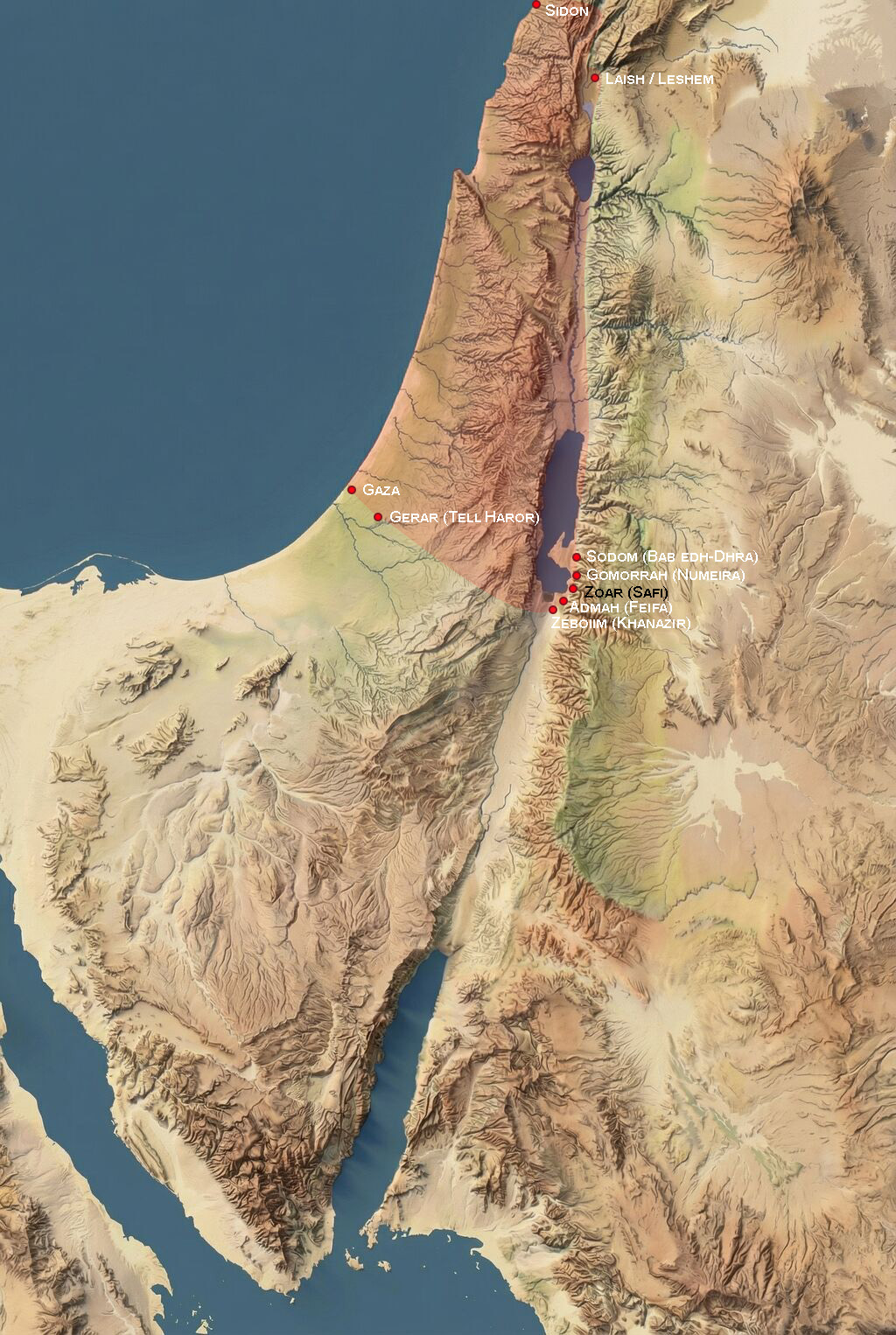 Image Caption: Relief map of Israel showing the location of Canaan's border cities mentioned in Genesis 10:19. Source: Israel Relief Map (Open Bible) [https://a.openbible.info/labs/ai-maps/images/1024/classic-swiss-style-shaded-relief-map-1.jpg]
According to Genesis 10:19, "the borders of Canaan reached from Sidon toward Gerar as far as Gaza, and then toward Sodom, Gomorrah, Admah and Zeboyim, as far as Lasha." The identification of לָֽשַׁע Lasha ('Fissure') is disputed. Ancient and modern historical geographers (including Targum Jerusalem, Eusebius' Onomasticon, Jerome, M.G. Easton, 'Lasha' in Illustrated Bible Dictionary, 3d edn, 1897) identify it with a ravine, Kallirrhoë / Callirrhoe (Ayn al-Zara), on the east shore of the Dead Sea, though some contend this site may have become established too late (first century BC) to qualify as a Canaanite border waypoint. The city at Tell Dan (Tell el-Qadi) formerly called לַיִשׁ Laish (Judges 18:7, 14, 27–29), לֶשֶׁם Leshem (Joshua 19:47), or לַ֖יְשָׁה Laishah (Isaiah 10:30) seems lexically unrelated, since all forms lack the final `ayin of לָֽשַׁע; still, if a miscopying had mistakenly appended final `ayin to Canaanite Laish / Leshem / Laishah, a northern city known to have been allied with Sidon, this city could function as a waypoint that brings the Canaanite border loop back toward Sidon, from which the account of Genesis 10:19 began.
Image Caption: Relief map of Israel showing the location of Canaan's border cities mentioned in Genesis 10:19. Source: Israel Relief Map (Open Bible) [https://a.openbible.info/labs/ai-maps/images/1024/classic-swiss-style-shaded-relief-map-1.jpg]
According to Genesis 10:19, "the borders of Canaan reached from Sidon toward Gerar as far as Gaza, and then toward Sodom, Gomorrah, Admah and Zeboyim, as far as Lasha." The identification of לָֽשַׁע Lasha ('Fissure') is disputed. Ancient and modern historical geographers (including Targum Jerusalem, Eusebius' Onomasticon, Jerome, M.G. Easton, 'Lasha' in Illustrated Bible Dictionary, 3d edn, 1897) identify it with a ravine, Kallirrhoë / Callirrhoe (Ayn al-Zara), on the east shore of the Dead Sea, though some contend this site may have become established too late (first century BC) to qualify as a Canaanite border waypoint. The city at Tell Dan (Tell el-Qadi) formerly called לַיִשׁ Laish (Judges 18:7, 14, 27–29), לֶשֶׁם Leshem (Joshua 19:47), or לַ֖יְשָׁה Laishah (Isaiah 10:30) seems lexically unrelated, since all forms lack the final `ayin of לָֽשַׁע; still, if a miscopying had mistakenly appended final `ayin to Canaanite Laish / Leshem / Laishah, a northern city known to have been allied with Sidon, this city could function as a waypoint that brings the Canaanite border loop back toward Sidon, from which the account of Genesis 10:19 began.
Genesis 10:20 — Sons of Ham Closing
| כ אֵלֶּה בְנֵי-חָם, לְמִשְׁפְּחֹתָם לִלְשֹׁנֹתָם, בְּאַרְצֹתָם, בְּגוֹיֵהֶם. {ס} | 20 These are the sons of Ham, by their families, by their tongues, among their lands, among their nations. {S} |
As in Genesis 10:5, which closed the Japheth nations, 'among their lands, every one by his tongue, by their families, among their nations', Genesis 10:20 repeats the Table of Nations compiler's aim to subdivide nations but this time in modified order: 'by their families, by their tongues, among their lands, among their nations' (cf. also 10:31). The compiler thus reminds his readers of a socio-linguistic and tribo-genetic patterning in humanity's migratory history.
Genesis 10:21-22 — Sons of Shem Opening
| כא וּלְשֵׁם יֻלַּד גַּם-הוּא: אֲבִי כָּל-בְּנֵי-עֵבֶר--אֲחִי, יֶפֶת הַגָּדוֹל. | 21 And unto Shem, the father of all the children of Eber, the elder brother of Japheth, to him also were children born. |
| כב בְּנֵי שֵׁם, עֵילָם וְאַשּׁוּר, וְאַרְפַּכְשַׁד, וְלוּד וַאֲרָם. | 22 The sons of Shem: Elam, and Asshur, and Arpachshad, and Lud, and Aram. |
Shem
Elam
Empire 2700-539 BC
Babylonia: ELAMTU
Greek: ELYMAIS
Persia: HUZ
Elam: HALAMTI
PUL (in Iran) = Polani migrated west (Poland)
HABROATIS (in Iran) = Chroasi & Serbi (Pliny) migrated west (Croatia & Serbia)
Asshur
‘Assyria … land of Nimrod’ (Micah 5:6) ASSHUR = SHAR KISHSHATI = Persian shah; Old Persian xšayathiya "king,“; Indo-Iranian *ksayati “have power over, rule“; Greek krasthai "to acquire, get," kektesthai "to possess“ Hindu: ASURAS (demons) Persia: AHURAS (spirits) Nineveh fell 612 BC; Assyrians migrate to Crimea (ASSYRIANI) and to Anatolia among Scythians (Diodorus Siculus 2:5:43). Romans call them GERMANI; Strabo 7:1:2: lists Assyrians among GALATAE (Gauls); Jerome (Letter 123:16, AD 400) lists Asshur among European invaders
Arpachshad
Josephus (Ant. 1:6:1): Arphaxad = Chaldeans
Hurrian (Nuzi Tablets, 1400 BC): ARP-HURRA
Akk: ARRAPHU
Ptolemy: ARPHAXITIS = KURO-ARAXES
Lud
LUD = LYDIANS (Josephus, Ant. 1:6)
Akk: LUDDU / LUDBU
Egypt: LUDEM
City LUDBU on Euphrates
Migrated to N. Italy with Etruscans, to ALBANIA, to GEORGIA (called GHEGS / KOSOVARS), to Algeria (KABYLES)
Aram
ARAM-NAHARAIM = Syria
Abram from HARRAN
(Gen. 24:10)
Assyrians exiled Arameans to Kir (Armenia)
Migrated to Iran (Josephus, Ant. 9:2:3) and to S. Russia (ARAMII) (Pliny, Nat. Hist. 4:18:50)
Genesis 10:21-22 — Sons of Shem: 'Sonless' Nations
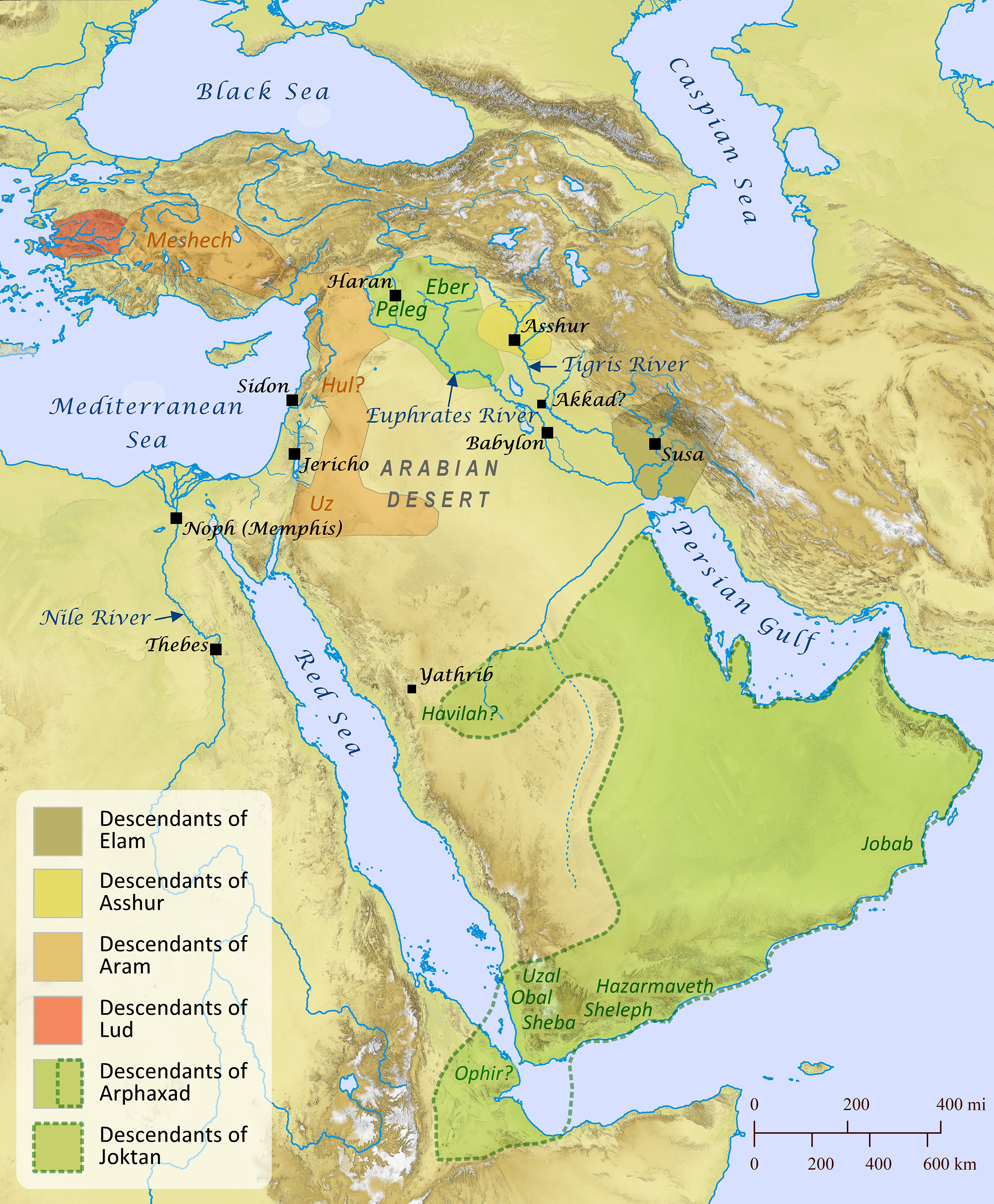 Image Caption: Map of Shem Nations. Source: Table of Nations: Shem (Bible Mapper) [https://biblemapper.com/blog/images/hi-res/TableOfNationsShem_high.jpg]
An reasoned estimate of the locales of people groups belonging to Japheth places them in the regions of the Fertile Crescent (Mesopotamia, Syria, and the Transjordanian Levant), Central and West Anatolia, and South Arabia. Remnants of these DNA haplogroups remain in these regions to this day.
Image Caption: Map of Shem Nations. Source: Table of Nations: Shem (Bible Mapper) [https://biblemapper.com/blog/images/hi-res/TableOfNationsShem_high.jpg]
An reasoned estimate of the locales of people groups belonging to Japheth places them in the regions of the Fertile Crescent (Mesopotamia, Syria, and the Transjordanian Levant), Central and West Anatolia, and South Arabia. Remnants of these DNA haplogroups remain in these regions to this day.
Elam
Elam is the progenitor of the Elamites (modern Persians), who were known to the Babylonians as the Elamtu, to the Greeks as Elymais, and whom the Romans knew as the Elymaci. The Elamites recorded their own name as the Haltamti. Subsequently, in the Old Persian inscriptions their name is rendered (h)uju, and huz in the Middle Persian, which is the archaic form of the modern Persian name of Khuzistan, which now covers what used to be the land of Elam. (Interpreter's Dictionary of the Bible (1962) 2:70. New Bible Dictionary (1972) 355-6. Josephus, Antiquities 1.vi.3. Matthew Poole Commentary on the Holy Bible 3 vols (1685) 1:28)
Asshur
Asshur is the founder of Assyria (modern northern Iraq). It may be possible to identify Asshur in the early king-lists of Assyria as Puzur Asshur I. According to these lists, Puzur Asshur I would have lived and reigned ca 1960 BC, which accords rather well with the biblical chronology. Asshur was one of the earliest men to be deified and worshipped by his descendants. Indeed, as long as Assyria lasted, that is until 612 BC, accounts of battles, diplomatic affairs and foreign bulletins were daily read out to his image; and every Assyrian king held that he wore the crown only with the express permission of Asshur's deified ghost. (Interpreter's Dictionary of the Bible (1962) 1:261. New Bible Dictionary (1972) 'Assyria' 100-7. Josephus, Antiquities 1.vi.3. Matthew Poole Commentary on the Holy Bible 3 vols (1685) 1:2)
Lud
The early descendants of Lud, the Ludim, were known to both the Assyrians and Babylonians as the Ludu. Josephus tells us that their land was later known as Lydia (a direct Greek derivation of the name Lud) which lay in western Asia Minor. (Josephus rendered the name Laud.) The Lydians were famed in the old world for the skill of their archers. They spoke an Indo-European (Japhetic) language, examples of which are to be found on certain Egyptian monuments. The land of Lydia was finally conquered by Cyrus, king of Persia, in the year 546 BC. (Interpreter's Dictionary of the Bible (1962) 3:178-9. New Bible Dictionary (1972) 755. Josephus, Antiquities 1.vi.3. Matthew Poole Commentary on the Holy Bible 3 vols (1685) 1:28)
Source: Bill Cooper, After the Flood [http://www.ldolphin.org/cooper/appen1.html]
Genesis 10:23 — Sons of Shem: Aram & Sons
| כג וּבְנֵי אֲרָם--עוּץ וְחוּל, וְגֶתֶר וָמַשׁ. | 23 And the sons of Aram: Uz, and Hul, and Gether, and Mash. |
Shem
Elam
Asshur
Arpachshad
Lud
Aram
Uz
Hul
Gether
Mash
Josephus: ‘Mesa (MASH) founded the MESANEANS’
Sargon captured city of MAS.
Dwelt in Elam as MASSADETAE.
Migrated to S. Russia (MESSGETAE), to Europe (MOESIANS / MAZOVIANS), to Poland (MAZURS)
Genesis 10:23 — Sons of Shem: Aram Nations
Aram
Image Caption: Map of Shem Nations. Source: Table of Nations: Shem (Bible Mapper) [https://biblemapper.com/blog/images/hi-res/TableOfNationsShem_high.jpg]
Aram was the progenitor of the Aramaeans, known to the Akkadians as the Aramu, but who were later known to the Greeks as the Syrians (from Serug? see 29.) In an Assyrian inscription of Tiglath-pileser I, from ca 1100 BC, the Aramaeans are depicted as living to the east of the river Tigris. By the time of Tiglath-pileser III, however, some 400j years later, they were living all over Mesopotamia. After they settled to the west, occupying roughly the same area makes up modern Syria. A clay tablet from Ur bears the of Aramu, and it is of interest to note that Aramaic is still spoken today. (Interpreter's Dictionary of the Bible (1962) 1:185. New Bible Dictionary (1972) 55-9. Josephus, Antiquities 1.vi.3. Matthew Poole Commentary on the Holy Bible 3 vols (1685) 1:28)
Uz
There is still considerable disagreement as to the precise area in which the descendants of Uz settled, and given the somewhat nomadic nature of the Aramaeans (Aram was the father of Uz), this is hardly surprising. Northern Arabia, between Babylon and Edom, seems the most likely area of settlement. (Josephus, probably correctly, identifies it as the classical Trachonitis.) (Interpreter's Dictionary of the Bible (1962) 4:741. New Bible Dictionary (1972) 1306-7. Josephus, Antiquities 1.vi.4. Matthew Poole Commentary on the Holy Bible 3 vols (1685) 1:28)
Hul
His descendants settled to the north of the sea of Galilee, where they gave their name to the lake and vale of Huleh (the biblical Waters of Merom, which were known to Josephus as Ul.) The place was notorious amongst Victorian explorers of Palestine for its tribes of Bedhouin robbers, and its far from healthy marshes and swamps which today have been drained, the reclaimed land being farmed and settled. The modern Israelis have also set up a nature reserve there, and know the place under its ancient name of the vale of Hula. The lake of Hula is formed by the accumulation of water from the two sources of the Jordan before beginning their descent to Galilee. (Interpreter's Dictionary of the Bible (1962) 2:658. Josephus, Antiquities 1.vi.3. Matthew Poole Commentary on the Holy Bible 3 vols (1685) 1:28)
Gether
Gether's descendants (known to Josephus as Gather) settled to the south of Damascus. Josephus identifies them as the latter-day Bactrians, famous amongst other things for a breed of camel. Whether this identification is correct or not cannot now be determined. It should, however, be noted that Bactria was populated by Aryan, or Japhetic, tribes in late Assyrian times, whereas the children of Gether were, of course, Semites. (Interpreter's Dictionary of the Bible (1962) 2:387. Josephus, Antiquities 1.vi.3. Matthew Poole Commentary on the Holy Bible 3 vols (1685) 1:28)
Mash
Akkadians rendered the name Mashu, which in turn was known to the Egyptians as Msh'r. It was also rendered Mishal, all of which names referred to a people that dwelt in Lebanon. However, in 1 Chronicles 1:17, the name is rendered Meshech, and this should not be confused with the Japhetic Meshech. Such confusion arises in Josephus and later in the 9th century historian Nennius. (Interpreter's Dictionary of the Bible (1962) 3:294. Matthew Poole Commentary on the Holy Bible 3 vols (1685) 1:28)
Source: Bill Cooper, After the Flood [http://www.ldolphin.org/cooper/appen1.html]
Genesis 10:24 — Sons of Shem: Arpachshad & Sons
| כד וְאַרְפַּכְשַׁד יָלַד אֶת-שָׁלַח; וְשֶׁלַח יָלַד אֶת-עֵבֶר. | 24 And Arpachshad bore Shelah; and Shelah bore Eber. |
Shem
Elam
Asshur
Arpachshad
Lud
Aram
Shelah
Eber
EBER = HEBREW
Egyptian: APIRU
Akk: HAPIRU
Genesis 10:24 — Sons of Shem: Arpachshad Nations
Arpachshad
Image Caption: Map of Shem Nations. Source: Table of Nations: Shem (Bible Mapper) [https://biblemapper.com/blog/images/hi-res/TableOfNationsShem_high.jpg]
Arpachshad was the progenitor of the Chaldeans, his name, apparently, corresponding to that of arp-keshed, the border marches of Chaldea. That he was indeed the forebear of the Chaldeans is confirmed by the Hurrian (Nuzi) tablets, which render the name as Arip-hurra--the founder of Chaldea. The name was also known to the Akkadians as Arraphu. Some scholars have endeavoured to treat his name as a derivative of the Assyrian phrase arba-kishshatu, meaning the four corners of the world. The Assyrians knew his descendants as the Kaldu, who were adept astrologers, magicians and mathematicians. Ptolemy recorded the name of their land as Arrapichitis, whilst it was known to others as Arphaxitis. Their very earliest settlement, however, would appear to be what is today a 2.5 acre ruin that still bears the name Arpachiya. It lies some four miles to the east of ancient Nineveh, and is the remains of a very early farming community. (Interpreter's Dictionary of the Bible (1962) 1:23 1. New Bible Dictionary (1972) 86. Josephus, Antiquities 1.vi.3. Matthew Poole Commentary on the Holy Bible 3 vols (1685) 1:28)
Shelah
Josephus renders the name Sala. (Interpreter's Dictionary of the Bible (1962) 4:319. New Bible Dictionary (1972) 1175. Josephus, Antiquities 1.vi.4)
Shelah (Hebrew: שֶׁלַח; also spelled Salah, Sala, or Selah), is the son of Arphaxad and the father of Eber, according to the Masoretic Text (MT) and Samaritan Pentateuch (SP), but the Septuagint (LXX) and Gospel of Luke insert an additional figure named Cainan between Arphaxad and Shelah. In MT Genesis 11:12–15, Arphaxad fathered Shelah at age 35 and lived an additional 403 years, while Shelah fathered Eber at age 30 and lived an additional 403 years (also 1 Chronicles 1:18, 24). In Luke 3:35–36 Sala is the son of Cainan and grandson of Arphaxad, following the LXX. (Shelah (son of Arphaxad) (Grokipedia) [https://grokipedia.com/page/Shelah_son_of_Arphaxad]). In all likelihood, the addition of Cainan into the LXX was a scribal error (homoioteleuton) (see Eric Lyons, 'Was Cainan the Son of Arphaxad?' (Apologetics Press) [https://apologeticspress.org/was-cainan-the-son-of-arphaxad-668/]).
Eber
Known to Josephus as Heber, he gave his name to the Hebrew race. Some have tried to identify him with Ebru, erstwhile king of Ebla, but this is unlikely on both chronological and ethnic grounds. The attempt to identify the children of Eber with the Habiru of the Egyptian chronicles may also be somewhat forced, although it is fair to add that, although we tend today to think only of the Jewish nation as Hebrews, in fact all of Eber's descendants would have been 'Hebrew', including Arabic-speaking Joktan tribes. (Interpreter's Dictionary of the Bible (1962) 2:5. New Bible Dictionary (1972) 331. Josephus, Antiquities 1.vi.3 and 5. Matthew Poole Commentary on the Holy Bible 3 vols (1685) 1:28)
Source: Bill Cooper, After the Flood [http://www.ldolphin.org/cooper/appen1.html]
Genesis 10:25 — Sons of Shem: Arpachshad: Eber
| כה וּלְעֵבֶר יֻלַּד, שְׁנֵי בָנִים: שֵׁם הָאֶחָד פֶּלֶג, כִּי בְיָמָיו נִפְלְגָה הָאָרֶץ, וְשֵׁם אָחִיו, יָקְטָן. | 25 And to Eber were born two sons; the name of the one was Peleg; for in his days was the earth divided; and his brother's name was Joktan. |
Eber
Peleg
Akk: PULUKKA / PALGU “to divide”
PALIGA / PHALGA city on Euphrates
Josephus: PELASGIANS
Migrated west to Asia Minor: PAPHLAGONIANS
Joktan
Joktan tribes settled in Arabian Peninsula
Genesis 10:25 — Sons of Shem: Arpachshad: Eber Nations
Peleg
Image Caption: Map of Shem Nations. Source: Table of Nations: Shem (Bible Mapper) [https://biblemapper.com/blog/images/hi-res/TableOfNationsShem_high.jpg]
Genesis tells us that in Peleg's day the earth was divided. The meaning of his name in Hebrew corresponds with the Akkadian noun pulukku, which means a dividing up of territory by means of boundaries and borders (the Akkadian verb for 'to divide' is palaku.) Likewise, the Assyrian word, palgu, refers to the dividing up of land by canals and irrigation systems. It is in this sense that the Hebrew word peleg is used in Job 29:6 and 38:5. The man named Peleg, (whose name appears as Phaleg in Josephus), was so named, however, after the division and scattering of the nations from Babel. In fact, one of the ancient names of Babylon (Babel) is nowadays translated as 'the place of canals', though surely a better translation would be 'the place of division,' or even the place of Peleg. There is an ancient city that bore the name of Peleg, however, the Akkadian town of Phalgu, whose ruins lie at the junction of the Euphrates and Chaboras rivers (Chebar, see Ezekiel 1:1.) Of further interest to us is the fact that the division of the nations is recorded in Genesis as occurring in the fifth generation after the Flood. We will encounter striking confirmation of this when we study the descent of certain European kings later. (Interpreter's Dictionary of the Bible (1962) 3:709. New Bible Dictionary (1972) 957. Josephus, Antiquities 1.vi.4. Matthew Poole Commentary on the Holy Bible 3 vols (1685) 1:28)
Joktan
Joktan is the progenitor of no less than thirteen south Arabic tribes. He is remembered amongst modern Arabs as Yaqtan. They consider only those Semitic Arabs descended from Joktan as the purest Arabs; while Hamitic Arabs are referred to somewhat disdainfully as Musta 'rabs, pretended Arabs. Joktan's name is preserved in that of the ancient town of Jectan near present-day Mecca. Josephus knew him as Joctan. (Interpreter's Dictionary of the Bible (1962) 2:963-4. New Bible Dictionary (1972) 652. Josephus, Antiquities 1.vi.3. Matthew Poole Commentary on the Holy Bible 3 vols (1685) 1:28)
Source: Bill Cooper, After the Flood [http://www.ldolphin.org/cooper/appen1.html]
Genesis 10:26-30 — Sons of Shem: Arpachshad: Eber: Joktan
| כו וְיָקְטָן יָלַד, אֶת-אַלְמוֹדָד וְאֶת-שָׁלֶף, וְאֶת-חֲצַרְמָוֶת, וְאֶת-יָרַח. | 26 And Joktan bore Almodad, and Sheleph, and Hazarmaveth, and Jerah; |
| כז וְאֶת-הֲדוֹרָם וְאֶת-אוּזָל, וְאֶת-דִּקְלָה. | 27 and Hadoram, and Uzal, and Diklah; |
| כח וְאֶת-עוֹבָל וְאֶת-אֲבִימָאֵל, וְאֶת-שְׁבָא. | 28 and Obal, and Abimael, and Sheba; |
| כט וְאֶת-אוֹפִר וְאֶת-חֲוִילָה, וְאֶת-יוֹבָב; כָּל-אֵלֶּה, בְּנֵי יָקְטָן. | 29 and Ophir, and Havilah, and Jobab; all these were the sons of Joktan. |
| ל וַיְהִי מוֹשָׁבָם, מִמֵּשָׁא, בֹּאֲכָה סְפָרָה, הַר הַקֶּדֶם. | 30 And their dwelling was from Mesha, as you go toward Sephar, the mountain of the east. |
Eber
Peleg
Joktan
Almodad
Sheleph
Hazarmaveth
Jerah
Hadoram
Uzal
Diklah
Obal
Abimael
Sheba
Ophir
Havilah
Jobab
Genesis 10:26-30 — Sons of Shem: Arpachshad: Eber: Joktan Tribes
Almodad
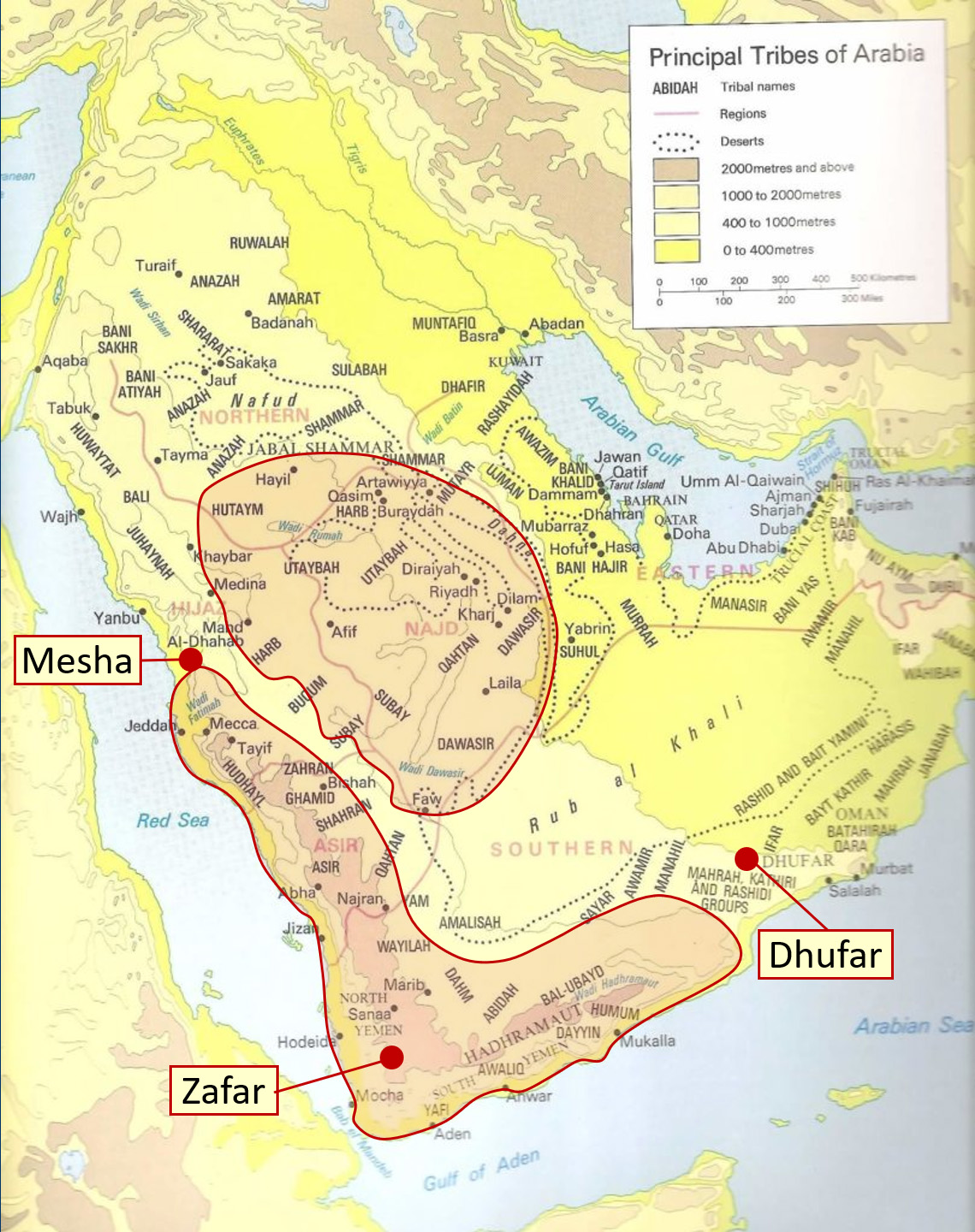 Image Caption: Map of Joktan Tribes. Source: Principal Tribes of Arabia (Saudi Arabesque) [http://saudiarabesque.com/traditional-woman-dress-of-hudhayl-tribe-saudi-arabia-and-elements-of-attire/]
Young gives Almodad's name as meaning 'The Agitator', which, if correct, hides what is no doubt a most interesting background. The name is certainly Arabic, his descendants being known to early Arab historians as the al-Morad tribe, who are seemingly to be identified with the Gebonites (the name is rendered Elmodad in Josephus.) Their precise area of settlement cannot now be determined. (Interpreter's Dictionary of the Bible (1962) 1:86. Josephus, Antiquities 1.vi.3. Matthew Poole Commentary on the Holy Bible 3 vols (1685) 1:28)
Image Caption: Map of Joktan Tribes. Source: Principal Tribes of Arabia (Saudi Arabesque) [http://saudiarabesque.com/traditional-woman-dress-of-hudhayl-tribe-saudi-arabia-and-elements-of-attire/]
Young gives Almodad's name as meaning 'The Agitator', which, if correct, hides what is no doubt a most interesting background. The name is certainly Arabic, his descendants being known to early Arab historians as the al-Morad tribe, who are seemingly to be identified with the Gebonites (the name is rendered Elmodad in Josephus.) Their precise area of settlement cannot now be determined. (Interpreter's Dictionary of the Bible (1962) 1:86. Josephus, Antiquities 1.vi.3. Matthew Poole Commentary on the Holy Bible 3 vols (1685) 1:28)
SheIeph
Rendered Saleph in Josephus, the name is of a southern Arabian tribe who were known to the pre-Islamic Arabs as the Salif. They were a Yemeni tribe whose capital, Sulaf, lay some sixty miles due north of present-day San'a. (Interpreter's Dictionary of the Bible (1962) 4:320. Josephus, Antiquities 1.vi.4. Matthew Poole Commentary on the Holy Bible 3 vols (1685) 1:28)
Hazarmaveth
Known as Asermoth in Josephus, his descendants populated the 200 mile long valley that runs parallel to the southern coast of Arabia. It is known to this day as the Hadramaut, a direct transposition into Arabic of the name Hazarmaveth. In pre-Islamic inscriptions, the name is variously rendered hdrmt and hdrmwt. Strabo tells us that the tribe of Hazarmaveth was one of the four main tribes of Arabs in his day. The name seems to mean 'town of death'--Hadramaut means the same in Arabic--although we can now only ponder the possible tragedy that lies behind it. (Interpreter's Dictionary of the Bible (1962) 2:539. New Bible Dictionary (1972) 507. Josephus, Antiquities 1.vi.3. Matthew Poole Commentary on the Holy Bible 3 vols (1685) 1:28)
Jerah
There lies, on the shores of Galilee, a ruined mound that is named Beth-Yerah, the house of Jerah, although this may not refer to the subject here. It is more likely that his descendants migrated into the southern regions of Arabia. Indeed, the Arab city that bore Jerah's name, and which was rendered by Ptolemy as Jerakon Kome, lay on the Mara coast close to the Hadramaut. The name appears as Jera in Josephus and as Yarki in the inscriptions of Ashurbanipal. (Interpreter's Dictionary of the Bible (1962) 2:821-2. New Bible Dictionary (1972) 605-6. Josephus, Antiquities 1.vi.3. Matthew Poole Commentary on the Holy Bible 3 vols (1685) 1:28)
Hadoram
Rendered Adoram in Josephus, it is that of a southern Arabian tribe, the name of whose town appears as Hurarina (Haroram) in the inscriptions of Ashurbanipal. It lay close to Yarki. (Interpreter's Dictionary of the Bible (1962) 2:508. New Bible Dictionary (1972) 500. Josephus, Antiquities 1.vi.3. Matthew Poole Commentary on the Holy Bible 3 vols (1685) 1:27)
Uzal
Arab historians render the name of Uzal as Azal (Josephus gives Aizel), and it is the ancient, pre-Islamic name for the city of San'a, the modern capital of Yemen (see 15.) Uzal's descendants are still doubtless thriving in the area. They knew the tribe of Uzal as the Azalla. (Interpreter's Dictionary of the Bible (1962) 4:741. New Bible Dictionary (1972) 1307. Josephus, Antiquities 1.vi.4. Matthew Poole Commentary on the Holy Bible 3 vols (1685) 1:28)
Diklah
The name Diklah appears in Akkadian records as Diklat, the Aramaeans knew it as Diklath, and the Assyrians gave it as Idiklat, all of which transpose into Greek as Tigris, the name of the valley and river that cuts through Mesopotamia. (Josephus renders it Decla.) This would give a clear indication as their place of settlement--either north of the Persian Gulf or in the north-east extremity of the Arabian peninsula. Procopius gives it as Phoinikon, which lay at the southern end of the Wadi Sirhan. (Interpreter's Dictionary of the Bible (1962) 1:843. Josephus, Antiquities 1.vi.4. Matthew Poole Commentary on the Holy Bible 3 vols (1685) 1:29)
Obal
A southern Arabian tribe whose name was rendered by Arab historians as Ebal. (Josephus has the same rendering.) Ancient inscriptions from Yemen give it as Abil, which elsewhere appears as Ubal. According to these sources the location of this tribe's place of settlement lies between the ancient Yemeni cities of Hadeida and San'a. (Interpreter's Dictionary of the Bible (1962) 3:579. New Bible Dictionary (1972) 'Ebal' 330. Josephus, Antiquities 1.vi.4. Matthew Poole Commentary on the Holy Bible 3 vols (1685) 1:29)
Abimael
His descendants settled in southern Arabia, where their existence is known from ancient Sabean inscriptions. (Interpreter's Dictionary of the Bible (1962) 1:9. Josephus, Antiquities 1.vi.4. Matthew Poole Commentary on the Holy Bible 3 vols (1685) 1:29)
Sheba
There are no less than three Shebas in the Table of Nations. Due to the presence in Arabia of both the Cushite and Jokshanite tribes of Sheba, it is impossible to determine where this particular patriarch's descendants settled. Josephus may give a clue in rendering the name as Sabeus. (Interpreter's Dictionary of the Bible (1962) 4:311-2. New Bible Dictionary (1972) 1171. Josephus, Antiquities 1.vi.4. Matthew Poole Commentary on the Holy Bible 3 vols (1685) 1:27)
Ophir
Its existence being duly noted in the pre Islamic Arabian inscriptions, this tribe's area of settlement is given by them as lying between Saba in Yemen and Hawlan. The name has been preserved in that of the coastal town of Ma'afir in south-west Arabia. (Interpreter's Dictionary of the Bible (1962) 3:605-6. New Bible Dictionary (1972) 911. Josephus, Antiquities 1.vi.4. Matthew Poole Commentary on the Holy Bible 3 vols (1685) 129)
Havilah
There were two Arabian tribes known under the name of Havilah. The first was of Hamitic descent, which settled in the eastern regions of the Arabian peninsula. Their land was known to Arabian cosmographers as Hawlan. Kautsch identifies them as the Huwailah, a people who settled on the Arabian shore of the Persian Gulf. The Semitic tribe, however, with whom we are dealing here, remained distinct, and occupied areas on the opposite side of the peninsula. In Strabo's day, they were still occupying areas of northern Arabia, their name being recorded by him as the Khaulotaei. Josephus knew them as the Euilat. The Arabian cosmographer Yakut, informs us that their dialect, Hawil, was spoken by 'the descendants of Midian, the son of Abraham. ' This Semitic tribe of Havilah also occupied the southernmost tip of the Arabian peninsula, crossing from there the Bab-el-Mandeb to the African coast. Here, both Ptolemy and Pliny refer to their city of Aualis on the Red Sea coast of Africa, which lay next to the modern state of Djibouti. This city (Aualis) is known today as Zeila. (Interpreter's Dictionary of the Bible (1962) 2:537. New Bible Dictionary (1972) 506. Josephus, Antiquities 1.vi.4. Matthew Poole Commentary on the Holy Bible 3 vols (1685) 1:29)
Jobab
Jobab's descendants were known to the Akkadians as the Labibi. They settled in the town that has long borne their founder's name, Juhaibab, which, according to Sabean inscriptions, lay close to modern Mecca. (Interpreter's Dictionary of the Bible (1962) 2:925. New Bible Dictionary (1972) 637. Josephus, Antiquities l.vi.4. Matthew Poole Commentary on the Holy Bible 3 vols (1685) 1:29)
Source: Bill Cooper, After the Flood [http://www.ldolphin.org/cooper/appen1.html]
Genesis 10:31 — Sons of Shem Closing
| לא אֵלֶּה בְנֵי-שֵׁם, לְמִשְׁפְּחֹתָם לִלְשֹׁנֹתָם, בְּאַרְצֹתָם, לְגוֹיֵהֶם. | 31 These are the sons of Shem, by their families, by their tongues, among their lands, by their nations. |
As in Genesis 10:5, which closed the Japheth nations, 'among their lands, every one by his tongue, by their families, among their nations', and Genesis 10:20, which closed the Ham nations, 'by their families, by their tongues, among their lands, among their nations', Genesis 10:31 repeats the Table of Nations compiler's aim to subdivide nations: 'by their families, by their tongues, among their lands, by their nations'. Through this refrain, the compiler reminds his readers of a socio-linguistic and tribo-genetic patterning in humanity's migratory history. To be sure, such repetition is formulaic, but the collocation of these phrases also serves to demarcate the Table of Nations into its three main sections: Japheth, Ham, Shem.
Genesis 10:32 — Sons of Noah Closing
| לב אֵלֶּה מִשְׁפְּחֹת בְּנֵי-נֹחַ לְתוֹלְדֹתָם, בְּגוֹיֵהֶם; וּמֵאֵלֶּה נִפְרְדוּ הַגּוֹיִם בָּאָרֶץ--אַחַר הַמַּבּוּל. {פ} | 32 These are the families of the sons of Noah, by their generations, among their nations; and from these were the nations divided in the earth after the flood. {P} |
As in Genesis 10:1, the chapter’s first verse, the chapter closes with a summary that these are the generations of the sons of Noah.
Also noteworthy are the words that close the chapter: אַחַר הַמַּבּוּל 'after the flood'. While these words makes overt the chronology proceding from the flood to the dispersion, it will become evident to readers that the genealogy of Genesis 10 also appears chronologically out of order with the following account of the tower of Babel (Genesis 11:1-9). The reason for this chronological reversal is likely literary — there is a pattern of alternation (paneling) between genealogies and narratives in Genesis 1–11 that wants a genealogy between the flood story and the tower of Babel story.
Sources
- Aschmann, Richard P. "The Genesis 10 Table of Nations and Y-Chromosomal DNA" [February 17, 2022] [https://aschmann.net/BibleChronology/Genesis10.pdf]
- Ayn al-Zara (Wikipedia) [https://en.wikipedia.org/wiki/Ayn_al-Zara]
- Ben-Gad HaCohen, David. Decoding the Table of Nations: Reading it as a Map (The Torah) [https://www.thetorah.com/article/decoding-the-table-of-nations-reading-it-as-a-map]
- Boström, Leif A. "Genetic Table of Nations" (September 20, 2011; updated November 10, 2014) [https://familjenbostrom.se/genealogi/dna/dna_table_of_nations.htm]
- Dan (ancient city) (Wikipedia) [https://en.wikipedia.org/wiki/Dan_(ancient_city)]
- Day, John. The Table of Nations: The Geography of the World in Genesis 10 (The Torah) [https://www.thetorah.com/article/the-table-of-nations-the-geography-of-the-world-in-genesis-10]
- Hirsch, Emil G. and Sayce, A. H. HAVILAH In Jewish Encyclopedia (1906) [https://www.jewishencyclopedia.com/articles/7343-havilah]
- Hodgen, M. Early Anthropology in the Sixteenth and Seventeenth Centuries. University of Pennsylvania, Philadelphia, 1971.
- Lasha (Biblexika) [https://www.biblexika.com/bible-places/lasha]
- Lasha (Wikipedia) [https://en.wikipedia.org/wiki/Lasha]
- Levin, Yigal. Nimrod, Mighty Hunter and King - Who Was He? (The Torah) [https://www.thetorah.com/article/nimrod-mighty-hunter-and-king-who-was-he]
- Ross, A.P. Creation and Blessing: A Guide to the Study and Exposition of Genesis. Grand Rapids: Baker, 1988.
- Speiser, Ephraim Avigdor. “In Search of Nimrod,” Eretz-Israel 5 (1958):32-36.